Place Maubert in 1867
By Delauney, Alfred Alexandre (Gouville-sur-Mer, 13–07–1830 - Nanteuil-sur-Marne, 25–06–1894), graveur - https://www.parismuseescollections.paris.fr/fr/musee-carnavalet/oeuvres/place-maubert-18#infos-principales, CC0, https://commons.wikimedia.org/w/index.php?curid=131698984
Who would imagine, walking along the Boulevard Saint Germain and through Place Maubert today, that this genteel corner of the Latin Quarter once had such a reputation? The place and its neighbouring streets were known for drinking dens and a criminal underworld. There was even a colourful name for the street toughs associated with the neighbourhood: “les Mohicans de la place Maub’” ("Mohicans of the Place Maubert"), in a newspaper passage attributed to L’Aurore in 1900.[^1]
La Maub’ was slang for Place Maubert. But Mohicans? How on earth did they end up being called that?
The trail leads back to London, nearly two centuries earlier. In 1710, four Indigenous North American leaders visited Queen Anne. Their arrival attracted considerable attention, and historians identify the visit as a likely background to the name of a group that would shortly become notorious: the Mohocks.[^2]
In the spring of 1712, London was full of stories about young men who drank heavily and then went out attacking people. Pedestrians were beaten or wounded, watchmen assaulted and sedan chairs overturned. Many of the alleged perpetrators were young men of wealth and standing. These particular street terrors had come from the comfortable side of society.[^2]
The Spectator of 12 March described a Mohock Club with an emperor and members who specialised in different cruelties. The newspaper attributed to them “An outrageous Ambition of doing all possible hurt to their Fellow-Creatures”. The name borrowed from the Mohawks gave their behaviour an explanation readers were expected to understand: these English gentlemen were behaving like the supposed “savages” of another continent.[^3]
The fear was real enough. Jonathan Swift recorded taking a sedan chair home to avoid the Mohocks, although he also wondered whether there was “no Truth or very little in the whole Story”. Historians have found evidence of assaults, but much less to support the elaborate picture of a single organised fraternity. Newspapers and pamphlets helped turn the violence into a larger legend. John Gay made it the subject of his farce The Mohocks that same year.[^4]
The story crossed the Channel. In 1765, the Encyclopédie included an entry headed “MOHOCKS ou MOHAWKS”. After repeating lurid stereotypes about the Indigenous people, it described the young English rakes who had taken their name and roamed London at night, assaulting those they encountered. French readers could find the American people and the European street attackers in the same short entry.[^5]
That does not tell us which later novelist first encountered the idea there. It does establish that the comparison was available in French long before the Parisian Mohicans appeared.
A fresh enthusiasm for American stories followed in the 1820s. Fenimore Cooper’s The Last of the Mohicans appeared in French in 1826. His novels supplied a memorable world of forests, tracking and ambushes. French writers could bring that world home: the city offered places to hide, people to pursue and unfamiliar communities whose customs could be described to curious readers.[^6]
The cover from James Fenimore Cooper’s The Last of the Mohicans (left, 1937); the title page from Alexandre Dumas, Les Mohicans de Paris (centre, 1907); illustration for Les Mohicans de Paris (right, 1863)
Credits: N. C. Wyeth / Charles Scribner's Sons; New York Public Library, via Internet Archive. Public domain. Book printing 1937, illustration 1919. Book scan: https://archive.org/details/lastofmohicansna00coop Cover scan: https://iiif.archive.org/iiif/lastofmohicansna00coop$1/full/1200,/0/default.jpg Physical title page: https://iiif.archive.org/iiif/lastofmohicansna00coop$7/full/1000,/0/default.jpg Art date and artist, Brandywine Museum: https://collections.brandywine.org/objects/1916/the-last-of-the-mohicans-cover-illustration N. C. Wyeth lived 1882-1945; the cover art was published in 1919 and its copyright has expired in France and the United States.
Alexandre Dumas, Les Mohicans de Paris, A. Le Vasseur et Cie, 1907 / University of Ottawa, via Internet Archive. Public domain. Book scan: https://archive.org/details/oeuvrescomplte19duma Title page: https://iiif.archive.org/iiif/oeuvrescomplte19duma$7/full/1000,/0/default.jpg Edition record: https://openlibrary.org/books/OL24758398M/Les_Mohicans_de_Paris
Héliodore Pisan, Les Mohicans de Paris, 1863 / Société des Amis d'Alexandre Dumas, via Wikimedia Commons. Public domain. Source and rights: https://commons.wikimedia.org/wiki/File:Pisan_-_Les_Mohicans_de_Paris_-_Croc-en-jambe_et_la_Gibelotte.jpg
Meanwhile, the fear of a strange, unfamiliar population within European cities was acquiring a sharper political meaning. After the Lyon silk workers’ uprising of 1831, Saint-Marc Girardin warned in the Journal des débats that the barbarians threatening society were close at hand: “ils sont dans les faubourgs de nos villes manufacturières” ("they are in the faubourgs and in our manufacturing towns"). He was talking about workers and the division between those who owned property and those who did not. Poverty and rebellion could be described in the same language as criminal violence.[^7]
By 1835, Balzac was making the comparison explicit. In Le Père Goriot, Vautrin tells the ambitious young Rastignac: “Paris, voyez-vous, est comme une forêt du Nouveau-Monde…” (“Paris, you see, is like a forest in the New World...") He goes on to name the Illinois and Hurons and to describe the different ways people hunt for money. The metaphor reaches into respectable society too—Rastignac, hoping to make his fortune, is a kind of hunter too.[^8]
Eugène Sue (a French novelist) then leads his readers into a more frightening part of the forest. Les Mystères de Paris began appearing in the Journal des débats on 19 June 1842. Its opening chapter introduces drinking dens frequented by released convicts, swindlers, thieves and murderers, before turning directly to Cooper’s descriptions of Indigenous Americans (in The Last of the Mohicans).[^9]
Sue proposes to describe other supposed barbarians, living within Paris itself. They have their own customs, their own language and nicknames referring to their strength, cruelty or physical peculiarities. He invites the reader on an excursion among “les naturels de cette race infernale”(" the natives of an infernal race"). An expedition into an allegedly alien society can begin a few streets from home.[^9]
There is something revealing in that invitation. Sue assumes his readers will find these Parisians as unfamiliar as the peoples in an American adventure story. Their speech requires explanation; their haunts must be entered with a guide. The distance is social, even though the people being described live in the same city, sometimes in the next street.
So when Alexandre Dumas began publishing Les Mohicans de Paris in 1854, he was working within an established literary tradition. He explicitly explained that Parisian Mohicans were named “en honneur du beau roman de Cooper” ("in honour of Cooper's good novel"). His use extended to entertainers and unconventional lives as well as criminals. It would be misleading to imagine all his Mohicans as members of a single gang—he’s effectively talking about a whole level of society.[^10]
The older London story was still circulating too. In 1860, the French writer Alphonse Esquiros recalled the Mohocks in the Revue des Deux Mondes and made a direct comparison with French fiction: “Comme les treize de Balzac…” ("Like Balzac's thirteen...") Both groups, he wrote, had declared war on humanity and formed an alliance among themselves. A French author was explicitly connecting the London legend with Balzac’s fictional conspirators.[^11]
By Godefroy, Henri Emile Cimarosa (Paris, 07–08–1837 - 19–09–1913), photographe - https://www.parismuseescollections.paris.fr/fr/musee-carnavalet/oeuvres/vue-ancienne-de-la-place-maubert-5eme-arrondissement-paris#infos-principales, CC0, https://commons.wikimedia.org/w/index.php?curid=138755465
That same year, another writer brought the American comparison straight to Maubert. In Les Dessous de Paris, Alfred Delvau described taking a foreign friend to see the neighbourhood’s Peaux-Rouges (“Redskins”). These were, he wrote, “ces sauvages de la civilisation, ces Peaux-Rouges du Paris moderne” (“these savages of civilisation, these redskins of modern Paris”). By 1860, the poor people around Place Maubert were already being presented through this American imagery.[^12]
The Mohocks continued to appear in French accounts of English history, including an article by Cornelis de Witt in 1864.[^13] Meanwhile, the Parisian vocabulary was developing its own variations. Historian Dominique Kalifa cites a court report from 1884 in which a heavily tattooed man accused of killing his brother-in-law was described as a “véritable Apache”. [^14]
Around 1900, Apaches became a familiar newspaper name for Parisian street criminals. In Le Matin on 12 December, Henry Fouquier described a Parisian tribe whose territory in Ménilmontant stood in for the Rocky Mountains. The American frontier had been transplanted to the heights of eastern Paris.[^15]
"L'Apache est la plaie de Paris": the cover of Le Petit Journal's illustrated supplement, 20 October 1907.
Credit: Le Petit Journal, supplement illustre, 20 October 1907 / Wikimedia Commons. Public domain; illustrator unidentified on the file page. Source and rights: https://commons.wikimedia.org/wiki/File:Le_Petit_Journal_-_Apache.jpg
The passage attributed to L’Aurore on 21 December 1900 placed Maubert’s Mohicans alongside the Apaches of Belleville, the Habits Noirs of the fortifications and the Terreurs of Ménilmontant. These neighbourhood names made the city sound like a collection of hostile territories. Precisely when the local Maubert nickname arose remains uncertain.[^1]
Yet by the time Paul Matter, a French magistrate and historian, wrote about the Left Bank’s Apaches in the journal La Revue politique et littéraire in 1907, he thought the old Maubert world was already disappearing. He recalled the place as a former gathering place for criminals and the site of a market in cigarette ends and tobacco scraps. It had been, in his words, a neighbourhood “aussi pittoresque que mal famé” (“as picturesque as it was disreputable”).[^16]
The opening of grand, wide Rue Lagrange, Rue Dante and other streets had, Matter argued, made this part of Paris more bourgeois and driven its underworld towards the southern outskirts. Even the Père Lunette, a drinking den notorious for its fights, had become a curiosity. Guides were bringing English visitors to inspect a little of the Parisian low life.[^16]
The Pere Lunette cabaret at 4 Rue des Anglais, photographed by Eugene Atget in 1902. (Still there but now an office. You can still see the “lunette” sign, bright yellow, hanging by the door, and there are (listed) paintings on the walls dating from the time of the cabaret.)
Eugene Atget / CC0 Paris Musees, Musee Carnavalet - Histoire de Paris (PH6888). https://www.parismuseescollections.paris.fr/fr/musee-carnavalet/oeuvres/le-cabaret-du-pere-lunette-4-rue-des-anglais-5eme-arrondissement-paris
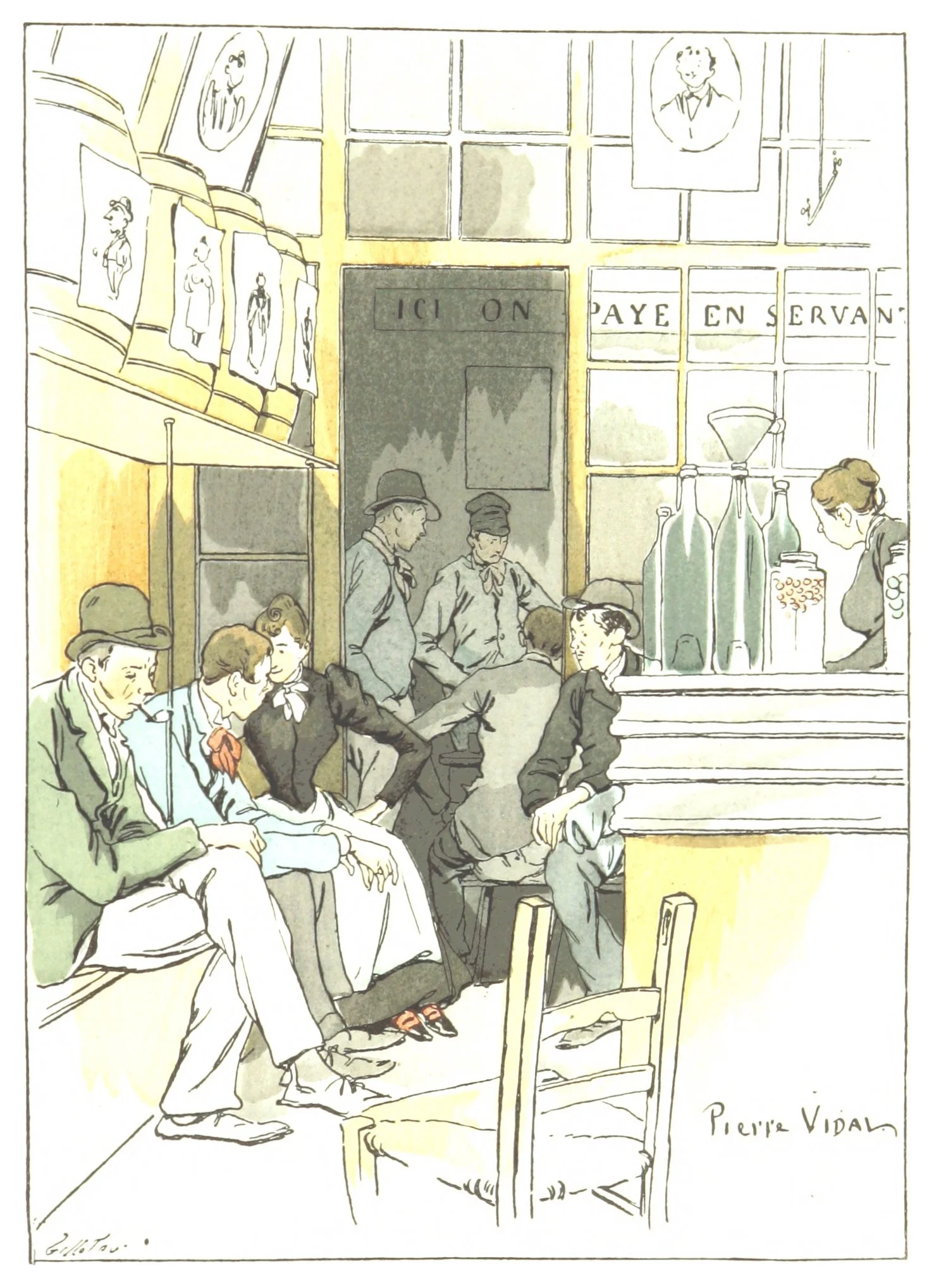
Inside the Pere Lunette: an illustration by Pierre Vidal from Emile Goudeau's Paris qui consomme (1893).
Pierre Vidal, in Emile Goudeau, Paris qui consomme (1893) / British Library, via Wikimedia Commons. Public domain.
https://commons.wikimedia.org/wiki/File:GOUDEAU%26VIDAL_-_Chez_le_P%C3%A8re_Lunette.jpg
The name continued to wander. In 1928, Jean Marèze published a series in Paris-Soir called Les Derniers Mohicans de Paris, combining Dumas’s title with Cooper’s. His reports ranged through immigrant communities and the world of nightlife and poverty, eventually reaching the homeless people of Place Maubert. Once again, the Mohicans included a much wider population than criminals.[^17]
And there is a particular irony in thinking about English visitors being shown the old drinking den. Nearly two centuries after London had feared its Mohocks, travellers from England were coming to Paris to be entertained by the neighbourhood of the Mohicans. That is quite a past for a quartier that now feels so thoroughly respectable.
Footnotes and References
[^1]: L’Aurore, 21 December 1900, as quoted by Mohammed Ibn Najiallah, “Les Racailles : des produits franco-français”, Le Club de Mediapart, 30 October 2024. The newspaper passage and its date are cited through this later quotation; the original issue has not been independently checked. For the neighbourhood’s earlier reputation, see also Paul Matter, note 16.
[^2]: David Walther, “Mohock scare”, The Digital Encyclopedia of British Sociability in the Long Eighteenth Century. Covers the 1710 delegation, the reported violence of 1712 and the distinction between documented assaults and the imagined Mohock Club. See also Daniel Statt, “The Case of the Mohocks: Rake Violence in Augustan London”, Social History, 20, no. 2 (1995), pp. 179–199.
[^3]: The Spectator, no. 324, 12 March 1712. Contemporary text reproduced in the DIGIT.EN.S anthology.
[^4]: Jonathan Swift, Journal to Stella, entries for March 1712; quotations reproduced in Walther, “Mohock scare”. Walther also discusses the contemporary press and John Gay’s The Mohocks: A Tragi-Comical Farce (London: Bernard Lintott, 1712). For the historical debate, see Neil Guthrie, “‘No Truth or very little in the whole Story’? A Reassessment of the Mohock Scare of 1712”, Eighteenth-Century Life, 20, no. 2 (1996), pp. 33–56.
[^5]: Denis Diderot and Jean le Rond d’Alembert, eds., Encyclopédie, first edition, vol. X (1765), p. 614, “MOHOCKS ou MOHAWKS”. The relevant volume appeared in 1765; the date 1751 in Wikisource’s general heading refers to the beginning of the series.
[^6]: James Fenimore Cooper, Le Dernier des Mohicans, French edition, 1826: CAT19 catalogue record, Université libre de Bruxelles. For Cooper’s reception and the transfer of American imagery to French urban life, see Dominique Kalifa, “Archéologie de l’Apachisme. Les représentations des Peaux-Rouges dans la France du XIXe siècle”, Revue d’histoire de l’enfance « irrégulière », no. 4 (2002), pp. 19–37, doi:10.4000/rhei.51.
[^7]: Saint-Marc Girardin, article on the Lyon silk workers’ uprising, Journal des débats, 8 December 1831. Contemporary text transcribed in “Les Barbares qui menacent la société…”, L’aimable faubourien, 13 January 2010. The article itself carries the dateline “Paris, 7 décembre”.
[^8]: Honoré de Balzac, Le Père Goriot, first published in 1834–1835. The quotation is from Vautrin’s conversation with Rastignac, checked in the 1855 edition published by Alexandre Houssiaux.
[^9]: Eugène Sue, Les Mystères de Paris, first part, chapter 1, “Le Tapis-franc”, Paris: Charles Gosselin, 1842. For the serial publication beginning on 19 June 1842, see the Bibliothèque nationale de France’s “Les Mystères de Paris en feuilleton”.
[^10]: Alexandre Dumas, Les Mohicans de Paris, first published from 1854, chapter 107, “Journaux, théâtres, grands hommes, publicistes, artistes, peintres, statuaires, comédiens, banquistes”. Quotation checked in the Calmann Lévy edition, 1885, vol. III, pp. 214–220; the reference to Cooper appears near the end of the chapter.
[^11]: Alphonse Esquiros, “L’Angleterre et la Vie anglaise. VIII. Les Clubs de Londres”, Revue des Deux Mondes, second period, vol. 26 (1860), pp. 769–820. Includes the explicit comparison between the Mohock Club and Balzac’s Treize.
[^12]: Alfred Delvau, Les Dessous de Paris (Paris: Poulet-Malassis, 1860), p. 113, quoted in Dominique Kalifa, “Archéologie de l’Apachisme”, especially note 60. The Delvau passage is cited here through Kalifa’s article.
[^13]: Cornelis de Witt, “La Société française au XVIIIe siècle. II”, Revue des Deux Mondes, second period, vol. 49 (1864), pp. 211–244.
[^14]: La Gazette des tribunaux, 28 July 1884, cited by Frédéric Chauvaud, Les Experts du crime. La médecine légale en France au XIXe siècle (Paris: Aubier, 2000), p. 84, and discussed by Dominique Kalifa, “Archéologie de l’Apachisme”, note 63. This is the source chain for the description of the tattooed defendant.
[^15]: Henry Fouquier, “Les Apaches”, Le Matin, 12 December 1900, quoted in the Bibliothèque nationale de France’s “Casque d’Or et les Apaches”.
[^16]: Paul Matter, “Chez les apaches”, La Revue politique et littéraire, 16 November 1907. The relevant extract is transcribed as “Les apaches de la rive gauche”. It covers Place Maubert, the tobacco-scrap market, the new streets, the Père Lunette and English visitors. For Matter’s career as a magistrate and historian, see the Cour de cassation’s 1938 memorial address.
[^17]: Mélodie Simard-Houde, “1928 : sur la piste des « derniers Mohicans de Paris »”, RetroNews, 4 July 2018. Discusses Jean Marèze’s 1928 Paris-Soir series and its account of Place Maubert.
Online sources consulted on 5 November 2026.