On the night of 28 October, a film about Miles Davis and Juliette Gréco came to my street. Le Onze, the bar at 11 rue Maître-Albert, had acquired a new name: Le Tabou. Filming continued through the night, bringing a little of post-war Saint-Germain-des-Prés to this corner of the Latin Quarter.
Miles & Juliette, currently being filmed in Paris, stars Damson Idris as Davis and Anamaria Vartolomei as Gréco. Bill Pohlad is directing, with Mick Jagger among the producers and the Miles Davis estate involved. It is being made in the centenary year of Davis’s birth.[^1]
The name on the bar referred to the celebrated cellar club in rue Dauphine, where Gréco and her friends helped make the late 1940s a memorable time to be young in Saint-Germain-des-Prés. Seeing Le Onze transformed for the film made me want to find out more about the relationship behind it.[^2]
Miles Davis, New York, around August 1947
William P. Gottlieb / Library of Congress. Wikimedia Commons
Their story began in May 1949, when Davis came to Paris to appear at the international jazz festival with pianist Tadd Dameron. He was twenty-two, already an accomplished musician who had played with Charlie Parker, but still at the beginning of the career that would make him one of the most influential figures in jazz. It was his first journey outside the United States.[^3]
Juliette Gréco, 7 March 1956
Harry Pot / Anefo / Nationaal Archief
Gréco, also twenty-two, was already a familiar figure in the cafés and clubs of Saint-Germain-des-Prés. Her friends included Boris Vian and Jean-Paul Sartre, and her singing career was just beginning. That year she performed at Le Bœuf sur le Toit; her first recordings followed in 1950.[^4]
She had arrived at this moment by a terrifying route. In 1943, aged sixteen, she and her older sister Charlotte had been arrested by the Gestapo in Paris and imprisoned at Fresnes. Her mother, who was active in the Resistance, and Charlotte were deported to Ravensbrück. Juliette was released because of her young age. She found herself alone in occupied Paris, without money and with only a métro ticket in her pocket. There was just one person she knew in the city to whom she could turn: Hélène Duc, her former French teacher in Bergerac and a friend of her mother’s. “She opened her arms to me,” Gréco later recalled.[^2][^13]
Their introduction took place at the Salle Pleyel. Gréco had no money for a ticket, so Michèle Vian, Boris’s wife, took her into the wings to watch the concert. She remembered seeing Davis in profile and being overwhelmed by the combination of his appearance and his music. Years later, she compared him to a Giacometti sculpture. Afterwards, they went out to dinner with a group.[^6][^7]
She spoke little English, and he spoke no French. Somehow they managed. Davis remembered walking beside the Seine with her, holding hands, kissing and looking into each other’s eyes. Those recollections have a youthful innocence that can be easy to overlook when both people have become such imposing cultural figures.[^7][^8]
His feelings for Gréco were bound up with his discovery of Paris. Through her and their friends, he entered a circle of artists, writers and intellectuals in which his music was taken seriously and he was welcomed as an equal. The experience changed his understanding of what his life could be. In his account, the pleasure of being with her and the freedom he felt in the city belong together.[^8]
One address associated with their relationship is Hôtel La Louisiane, at 60 rue de Seine, where both stayed. Gréco lived among the artists and writers who made the hotel part of the neighbourhood’s social life. Sartre and Simone de Beauvoir had rooms there too. It provides another very tangible Paris setting for their story, alongside Pleyel and their walks beside the river.[^2][^9]
Writing about La Louisiane, the author John Baxter introduces Davis with the words: “The man who would become the love of her life arrived in May 1949…”[^10]
But Davis’s visit lasted only a couple of weeks. He had a partner, Irene, and two children in America, as well as a musical life to return to. He and Irene had never legally married. He went home, and the contrast between his experience in Paris and the life awaiting him in the United States was painful. Those existing commitments belong in the story alongside the racial prejudice that made a shared future so difficult to imagine.[^3][^11]
Gréco often recalled Sartre asking Davis why he did not marry her. His answer, in the version she gave in a 2012 interview, was simply: « Parce que je l’aime » — because I love her. She understood what he meant: he knew the hostility she would face in America as the white partner of a Black man. The words have been retold in several forms, but she returned to the same explanation.[^12]
Later, while staying at New York’s Waldorf Astoria, she invited him to dinner and encountered that hostility herself. She remembered the insulting way they were served and a distressed telephone call from Davis afterwards. In her account, he told her that they could not have such a relationship in his country. It was an experience she recalled with anger and hurt decades later.[^6]
Paris was not free of such prejudice either. In the same 2012 interview, Gréco described a maître d’hôtel refusing to find them a table because Davis was Black. She responded by spitting into his hand. Davis, she said, never forgot it. The Paris they loved could offer them a remarkable freedom without offering complete protection from racism.[^12]
Looking back in 2006, Gréco told Philippe Carles of Jazz Magazine: “Between Miles and me it was a superb love affair, the kind I wish many people could experience.”[^7]
Their lives went in different directions, but they never lost contact. As their tours crossed, Davis sometimes left messages for her, regretting that they had missed each other. She remembered him as someone who had loved her before he had even heard her sing. She also recalled the private pleasure of hearing him play Bach, whom he adored, including once while he was in the bath.[^7]
He came to see her a few months before his death in 1991. In her recollection, he sat in the salon and began to laugh as she stood with her back to him. When she asked why, he told her he would recognise her from behind anywhere in the world.[^7]
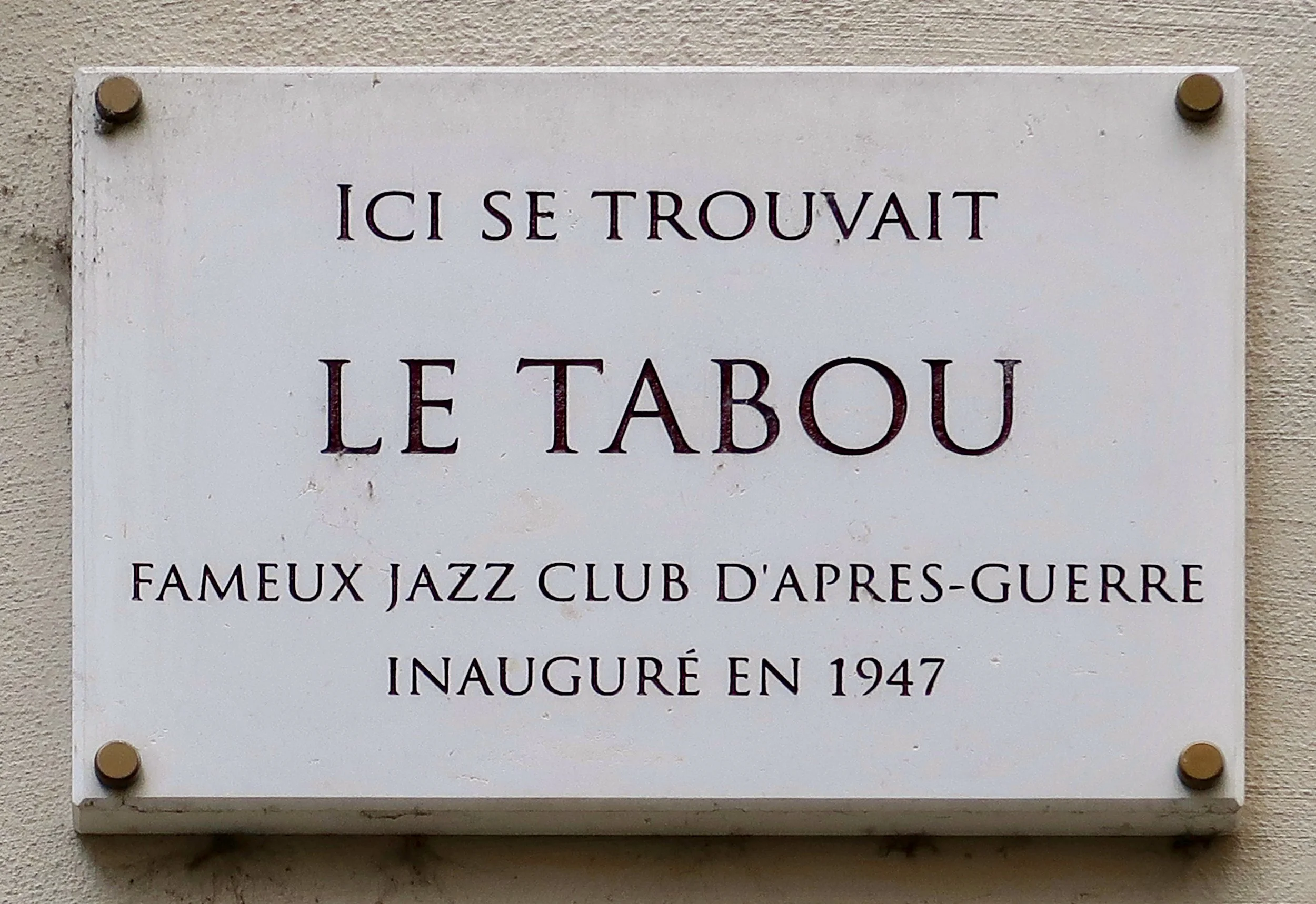
Photographed in 2019 at the corner of rue Dauphine and rue Christine.
Celette; perspective correction by Paris 16 / Wikimedia Commons / CC BY-SA 4.0.
Their story is poignant because a love that lasted for decades never became a life together. The contrast between the freedom Davis found in Paris and the humiliation they faced in New York makes the racial barriers of the time painfully clear: these were pressures that reached into the most private parts of people’s lives. Their relationship also gives us a glimpse of a very different Saint-Germain-des-Prés—a neighbourhood of cheap hotel rooms, writers working at café tables and jazz spilling out of cellar clubs. It is fascinating to think that these familiar streets once held such a different world.
Footnotes and References
[^1]: Miles Davis Estate, “Miles Davis Estate Unveils Miles Davis 100 Logo Ahead of Historic Centennial Celebration”, 22 January 2026, Miles Davis Official Site. For filming in progress, see “French protests hit local box office but admissions rebound, productions largely unaffected”, Screen Daily, October 2026. Miles Davis Estate; Screen Daily.
[^2]: Ville de Paris, “Juliette Gréco a désormais sa place à Paris”, updated 5 October 2021. This article follows Gréco’s own recollection of an introduction at Pleyel; some later accounts place their meeting at La Louisiane. Source.
[^3]: Miles Davis Official Site, “Timeline 1945”, entries for May–June 1949. Davis’s birth date, 26 May 1926, establishes that he was still twenty-two when he arrived in Paris. 1945–1949 timeline; early-life timeline.
[^4]: Bibliothèque nationale de France, “Hommage à Juliette Gréco (1927–2020)”, 2020; and Frémeaux & Associés, booklet notes for Juliette Gréco — Live in Paris, catalogue FA5750. The latter dates her debut at Le Bœuf sur le Toit to 22 June 1949 and her first Columbia recording session to 30 June 1950. BnF; Frémeaux & Associés.
[^5]: “La chanteuse Juliette Gréco est morte”, Le Monde, 23 September 2020. Her mother and sister survived deportation, and Gréco was reunited with them in May 1945. Source.
[^6]: Europe 1, “Archive Europe 1 — Juliette Gréco raconte son histoire d’amour avec Miles Davis”, an archive article drawing on her 2007 interview with Isabelle Morizet in Il n’y a pas qu’une vie dans la vie. Source.
[^7]: Philippe Carles, interview with Juliette Gréco, Jazz Magazine, no. 570, May 2006; extracts republished as “Quand Juliette Gréco se souvenait de Miles Davis”, 23 September 2020. The English quotation beginning “Between Miles and me…” is translated from the French. Her recollections of their meeting, continued contact and last visit also come from this interview. Source.
[^8]: Stanley Nelson, director, Miles Davis: Birth of the Cool (2019), broadcast by PBS American Masters in 2020. The online transcript includes passages from Davis’s autobiography, written with Quincy Troupe, about Gréco, their walks beside the Seine and his experience of Paris. Source.
[^9]: Hôtel La Louisiane, “Notre Histoire”, particularly its account of the hotel’s writers, artists and jazz musicians. Source.
[^10]: John Baxter, “There’s a Small Hotel: With Miles and Juliette at the Louisiane”, Aussie on the Metro, 12 November 2022. “The love of her life” is Baxter’s description of Davis; it is not presented here as Gréco’s own phrase. Source.
[^11]: Miles Davis with Quincy Troupe, Miles: The Autobiography (New York: Simon & Schuster, 1989). Davis states explicitly that he and Irene were never legally married. See also Marilyn Brouwer, “Miles Davis and Two Love Affairs, Paris and Juliette Greco”, Bonjour Paris, 9 May 2018, for the partner and children awaiting him in America. Bonjour Paris.
[^12]: Interview with Juliette Gréco, “Je ne supporte pas la médiocrité”, Le Parisien, 6 February 2012. Source for her version of Sartre’s marriage question and her recollection of the maître d’hôtel who refused them a table. Source.
[^13]:Interview with Juliette Gréco, “Juliette Gréco : « Cela fait 88 ans que je suis en guerre »”, Le Monde, 6 December 2015. Gréco describes her arrest, release and refuge with Hélène Duc. The quotation is translated from French.