I was exploring the Sentier recently when I spotted a plaque marking Élisabeth Vigée Le Brun’s former home. Seeing her name on a Paris building brought her back to mind and prompted me to write about her.
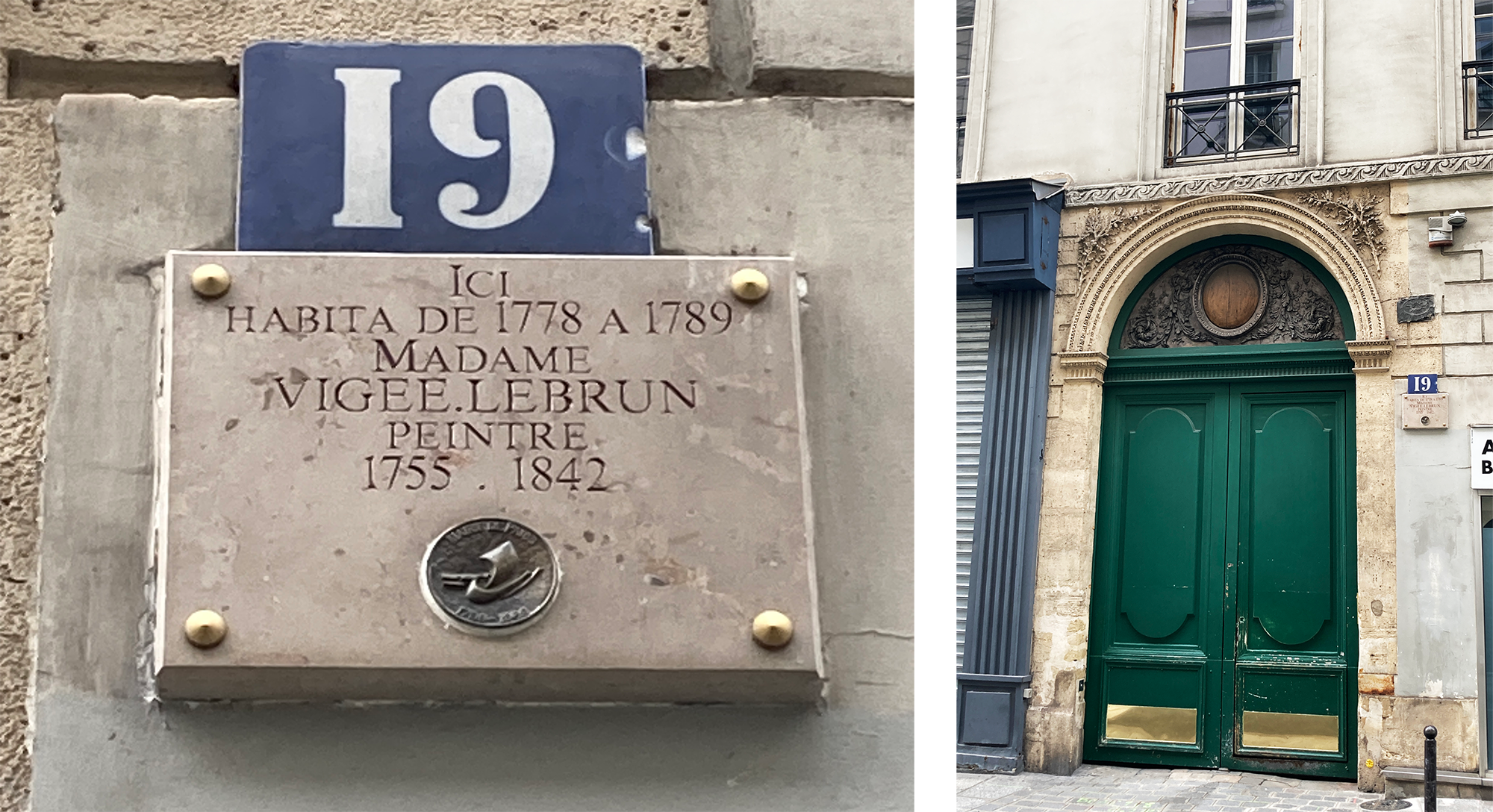
Plaque outside, and the front door of Vigée Le Brun’s home at 19 rue de Cléry, in the 2nd arrondissement. The historic property covered 19–21 rue de Cléry, extending through to 8 rue du Sentier, formerly called rue du Gros-Chenet.
Photo: Paris Footprints
The artist first caught my attention while I was visiting the Château de Lavoûte-Polignac in the Haute-Loire, a place I know and love. There's a copy of one of her paintings there, of Yolande de Polastron, Duchess of Polignac, one of Marie Antoinette’s closest friends. She wears a straw hat, and a self-portrait I knew from the National Gallery in London immediately leapt to mind, in which the artist is also wearing a straw hat and has a similar direct gaze towards the viewer.[^1] Sure enough, this portrait was by the same artist—Élisabeth Vigée Le Brun.
These portraits obviously come from another era and could be dismissed as too obviously pretty for our modern tastes, but both paintings, as well as being decorative to look at, have a certain touching sweetness and candour about them. I was interested, too, because she was a female painter—there aren’t so many eighteenth-century women painters whose work I can immediately recognise. So I looked her up.
The Self-portrait in the National Gallery, London.
By Élisabeth Louise Vigée Le Brun - http://www.nationalgallery.org.uk/paintings/elisabeth-louise-vigee-le-brun-self-portrait-in-a-straw-hat, Public Domain, https://commons.wikimedia.org/w/index.php?curid=23940843
The portrait of the Duchess of Polignac, a copy of which hangs at the Château de Lavoûte-Polignac.
By Élisabeth Louise Vigée Le Brun - Wadsworth Atheneum Museum of Art by Facebook, Public Domain, https://commons.wikimedia.org/w/index.php?curid=133628280
It turned out that the painter had been a complete superstar at the time and had a fascinating life.
Born in Paris in 1755, Élisabeth Vigée Le Brun was the daughter of Louis Vigée, a portrait painter who worked in pastels. He encouraged her early enthusiasm for drawing, which seems to have been fairly unstoppable. At her convent boarding school she drew on her books and even on the walls. Very sadly, her father died when she was only twelve. Her mother remarried very soon after, and Élisabeth found herself living with a stepfather whom she detested.[^2]
By the time she was fifteen she already had paying portrait clients. She was doing remarkably well, but it seems that her stepfather pocketed any earnings she made. When the family moved into the Hôtel Lubert on rue de Cléry, however, she found herself with an interesting and useful neighbour.
Jean-Baptiste-Pierre Le Brun was an art and antiques dealer, and his rooms were full of paintings. He lent the young artist pictures to copy. What a perfect situation—living in the same building as someone who could put beautiful works by the masters at your disposal. She studied them at close quarters, tried things out and learned from them.
Then he asked her to marry him.
The young woman was not particularly keen. He had a reputation as a gambler. Her mother thought he was an excellent prospect and urged her to accept, but what seems to have helped decide her was the chance to get away from her stepfather. They married in 1776.
It seems that the marriage was not a success. Her husband’s knowledge of paintings and his contacts were useful to her, but he spent money too freely. In her memoirs, she blamed him for consuming both his fortune and hers. She earned enormous amounts; very little of it remained under her control.[^3]
This is Elisabeth’s husband, a self-portrait, 1796
By Jean-Baptiste-Pierre Le Brun - www.metmuseum.org, Public Domain, https://commons.wikimedia.org/w/index.php?curid=61405162
Meanwhile, her career was rocketing; she had become sought-after by high society. Her first royal commission was from the Count of Provence.[^4] By 1778—at only 23—she was painting Queen Marie Antoinette, who liked her work and kept coming back for more (all in all, she painted over 30 portraits of the Queen). In 1783, with royal support, she was admitted to the Académie royale de peinture et de sculpture. She was 28, and one of only four women members.
Her husband’s profession had nearly kept her out. The Academy excluded people involved in the art trade, and his occupation counted against her. The same marriage that gave her access to paintings and clients could also shut a door in her face. Her own skill and perhaps personal flair with people had opened the door again for her.[^5]
I can see why her portraits were so successful. They are delightful to look at. Of course they are flattering—her clients were paying to have themselves painted, and the artist needed them to love the result. The person had to look good. But the faces have life in them. You feel that there is somebody there, enjoying the attention, or perhaps a little amused by it. Whoever she was painting, you sense that the artist relished the challenge of creating something beautiful.
She had skill in spades. Look at the way she handles textures. Look at this portrait of a woman holding a huge fluffy muff—the texture of the fur is beautifully carried off. Beside it, the texture of the gauzy fabrics, the sheen of silk or satin, the sitter’s hair, and the feather in the hat are all quite different from one another.
Madame Molé-Reymond, an actress from the Comédie Italienne (1786)
By Élisabeth Louise Vigée Le Brun - Sammyday (2010-10-23), Public Domain, https://commons.wikimedia.org/w/index.php?curid=12624590
Vigée Le Brun’s pictures of Marie Antoinette were so successful that she was made the Queen's official portrait artist—although one caused an absolute scandal.
At the Salon of 1783, she showed the Queen wearing a loose white muslin dress and a straw hat. This was the sort of informal dress Marie Antoinette liked to wear in her private circle, but the public objected strongly to this being seen in public. It looked far too much like a chemise, an undergarment. It’s hard to imagine it being so shocking when we look at the picture today, but if we understand that it was as if a picture of the Queen in her dressing gown, or in a tracksuit, had been put on public display, it’s a little easier to comprehend.
Of course the painting had to come down. Its replacement showed Marie Antoinette in a much more proper gown of blue-grey silk, holding a rose. She holds a rose in the muslin portrait too, actually. It's a clever device—I don't think Marie Antoinette was a very pretty woman, and of course the portrait had to present her positively. The flower brings out the pink in her cheeks and her porcelain complexion and makes her look delicate and feminine. The rather more formal clothes and her upright stance in the second portrait do the job in making her look appropriately stately.[^6]
This is the shocking portrait that caused such a scandal.
By Élisabeth Louise Vigée Le Brun - Collection of the prince Ludwig von Hessen und bei Rhein, Wolfsgarten Castle, Germany., Public Domain, https://commons.wikimedia.org/w/index.php?curid=141783
This is the more proper portrait that replaced it.
By Élisabeth Louise Vigée Le Brun - Google Arts & Culture — qwHgKqLoAQb9FQ, Public Domain, https://commons.wikimedia.org/w/index.php?curid=13398897
The portrait of the Queen in a muslin dress might have caused a scandal, but afterwards, Vigée Le Brun’s paintings were even more highly in demand and could command still higher prices.
The Le Bruns were living extremely well in Paris. They bought the Hôtel Lubert, where they had first met, and in the 1780s commissioned Jean-Arnaud Raymond to extend into the space behind. There was room for his art business and for her paintings, as well as for entertaining on a considerable scale.
The property stretched between two streets, with buildings around a garden, a picture gallery and a room used for auctions and concerts. Parts of it survive at 19–21 rue de Cléry and 8 rue du Sentier, including curved façades around a circular courtyard, although the auction room used by her husband is no longer there.[^7]
Élisabeth Vigée-Lebrun, Self-portrait with her daughter Julie (1786). Louvre, Paris, Public Domain, https://commons.wikimedia.org/w/index.php?curid=49025553
Vigée Le Brun gave society dinners here, including one that acquired a quite extraordinary reputation. She had been hearing a description of an ancient Greek meal and decided it would be fun to give one. Her studio was full of fabrics for draping her models, so she used them to dress the guests. A neighbour supplied antique cups and vases. She arranged the table and the room, and the company spent the evening looking like people in a classical painting. (No wonder she got on so well with Emma Hamilton when she met her in Naples—Emma was also keen on wearing ancient Greek-style drapes.)
The story soon became one of outrageous extravagance. According to her memoirs, the dinner was said to have cost 20,000 francs at Versailles, 40,000 in Rome and 60,000 in Vienna. By the time she heard about it in St Petersburg, the bill had reached 80,000! She said she had actually spent fifteen francs. This shows how far her fame was spreading.[^8]
Vigée Le Brun's memoirs were written much later, and she was certainly defending herself. Even so, the steadily growing cost of this dinner makes one doubtful of the veracity of some of the other stories told about her. There was plenty of gossip about supposed affairs with rich and powerful men—they might have been true, or they might not. A woman who was beautiful, successful and earning a fortune was evidently difficult to leave alone.
Rumours circulated that Vigée Le Brun was having an affair with Charles Alexandre de Calonne, Louis XVI’s finance minister (1784)
By Élisabeth Louise Vigée Le Brun - cQGHDF7RxrnPWQ at Google Cultural Institute maximum zoom level, Public Domain, https://commons.wikimedia.org/w/index.php?curid=22126808
Then, in the summer of 1789, she was at Louveciennes painting Madame du Barry, Louis XV’s former mistress, when the two women heard cannon fire from Paris. I find that an extraordinary scene to imagine. They did not know exactly what was coming, but they knew there was danger on the way.[^9]
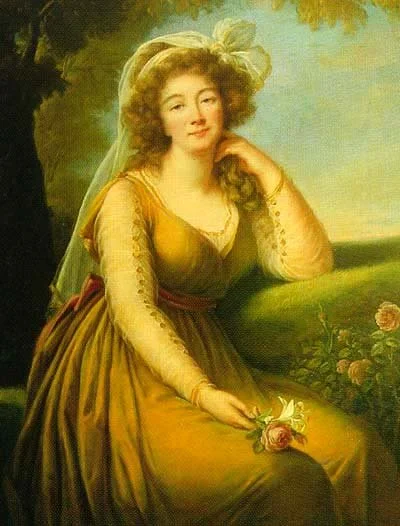
Portrait of Madame du Barry, started in 1789. Louis XV’s mistress was guillotined in 1793.
By Élisabeth Louise Vigée Le Brun - http://www.batguano.com/dubarryit.html#C(Originally uploaded on en.wikipedia) http://historyandotherthoughts.blogspot.com/2011/11/madame-vigee-lebrun-about-madame-du.htmlAuthor: JoJan (Transferred by File:/Originally uploaded by Ghirlandajo), Public Domain, https://commons.wikimedia.org/w/index.php?curid=17967898
The atmosphere in Paris grew terrifying. During the night between the 5th and 6th October, Vigée Le Brun fled Paris with her daughter Julie and Julie’s governess. Associated as she was with the Queen and her aristocratic circle, even though she was only a painter and not an aristocrat herself, her only safe choice was to leave—and seeing how things turned out, she absolutely made the right call. Her husband stayed in Paris.
Vigée Le Brun travelled via Lyon and Savoy to Rome. She was recognised by a carriage driver on the journey, despite being in disguise: "Madam is not a worker, we know who she is... You are Madame Lebrun, who paints to perfection." Vigée Le Brun was shocked and very scared, interpreting it to mean there were Jacobin spies everywhere. [^10]
Vigée Le Brun's absence turned into more than twelve years; she painted her way around Europe. In Naples she met Lady Hamilton, later Lord Nelson's mistress, whose beauty and expressive poses delighted her. In Vienna and St Petersburg she painted aristocrats and members of royal families. French émigrés knew who she was, and foreign patrons wanted their portraits done by the woman who had painted Marie Antoinette. Her reputation travelled with her, and she continued to charge handsomely for her work.[^11]
Lady Hamilton in Naples (1790)
By Élisabeth Louise Vigée Le Brun - This file was derived from: Élisabeth Vigée-Lebrun - Portrait of Lady Hamilton (1761–1815).jpg:, Public Domain, https://commons.wikimedia.org/w/index.php?curid=109113245
Varvara Ivanovna Ladomirskaya, painted in Moscow (1800)
By Élisabeth Vigée Le Brun, Varvara Ivanovna Ladomirskaya, 1800. Columbus Museum of Art, Ohio. Public domain, via Wikimedia Commons.
Portrait of Young Woman (1797)
By Élisabeth Louise Vigée Le Brun - 1. Web Gallery of Art: Image Info about artwork2. Self-scanned3. Museum of Fine Arts, Boston, Public Domain, https://commons.wikimedia.org/w/index.php?curid=466622
She had to earn a living, but it is hard to imagine her being idle anyway. In her memoirs, she recalls painting in her studio between contractions on the day Julie was born—apparently even giving birth could not persuade her to put down her brushes.[^12]
Her husband, meanwhile, was trying to get her name removed from the list of émigrés. People on that list could have their property confiscated, which threatened him as well. He published a defence of her in 1793, but the following year he obtained a divorce to protect himself and his property.
Their marriage had clearly been difficult, but this was also happening during the Revolution. It's hard to know how to read what happened, but it is too simple to picture him disowning her as she fled. He didn't seek the divorce until several years after she had left.[^13]
Vigée Le Brun finally returned to Paris in January 1802. I can't imagine how it was to come back. So many of the people she had known were dead. The Queen, whose face she had painted over and over again, had been executed. The parties, the dinners and the world in which she had become famous were gone—although, of course, there were friends still there, with whom she reunited joyfully.
She did not settle down immediately. She went to Britain and Switzerland and continued travelling, eventually buying a country house at Louveciennes. Perhaps she had acquired a taste for moving about. Perhaps Paris was difficult to return to. We can imagine both being true.
When Vigée Le Brun died in Paris in 1842, aged eighty-six, she had lived under Louis XV and Louis XVI, through the Revolution and Napoleon’s Empire, and on through the Restoration and the July Monarchy. That is an enormous amount of history to have seen.[^14]
I don't understand how this woman, who had been so famous and so much in demand, became much less familiar to later generations. Her work was neglected for long stretches of the nineteenth and twentieth centuries, before a more recent reassessment.[^15]
I wonder whether the prettiness of the paintings worked against her. Were they too charming, too flattering, too full of beautifully dressed women to be taken seriously? Were they regarded as too feminine? It's hard to understand when there is so much skill and personality in her work.
The Grand Palais held the first French retrospective of her work from September 2015 to January 2016. I was able to go and see a vast collection of her portraits. They were absolutely wonderful.[^16]
Footnotes and References
[^1]: National Gallery, London, [*Self Portrait in a Straw Hat*, Élisabeth Louise Vigée Le Brun, 1782](https://www.nationalgallery.org.uk/paintings/elisabeth-louise-vigee-le-brun-self-portrait-in-a-straw-hat), collection entry.
[^2]: Joseph Baillio, Katharine Baetjer and Paul Lang, [*Vigée Le Brun*](https://www.metmuseum.org/met-publications/vigee-le-brun) (New York: The Metropolitan Museum of Art, 2016), opening biographical essay and “Chronology of the Life of Elisabeth Louise Vigée Le Brun,” pp. 241–242. See also Élisabeth Louise Vigée Le Brun, Souvenirs, vol. I (Paris: H. Fournier, 1835), letters I–III, for her childhood, schooling and family circumstances.
[^3]: Vigée Le Brun, [*Souvenirs*, vol. I](https://www.gutenberg.org/cache/epub/23019/pg23019-images.html), letters II–IV, especially letter IV on the Hôtel Lubert, the paintings Le Brun lent her, her reasons for marrying him and her account of his spending.
[^4]: Château de Versailles, [“Acquisition d’un pastel de Vigée Le Brun”](https://www.chateauversailles.fr/presse/collections/acquisition-pastel-vigee-brun), 17 June 2025. The museum identifies the commission for portraits of the Count of Provence in 1776 as her first official royal commission.
[^5]: Château de Versailles, [“Élisabeth Louise Vigée Le Brun”](https://en.chateauversailles.fr/discover/history/great-characters/elisabeth-louise-vigee-brun); The Metropolitan Museum of Art, [“Vigée Le Brun: Woman Artist in Revolutionary France”](https://www.metmuseum.org/exhibitions/listings/2016/vigee-le-brun), exhibition overview, 2016. These accounts discuss Marie Antoinette’s patronage, the artist’s admission to the Academy in 1783 and the obstacle posed by her husband’s profession.
[^6]: Baillio, Baetjer and Lang, [*Vigée Le Brun*](https://www.metmuseum.org/met-publications/vigee-le-brun), catalogue entries 16–17, Marie Antoinette in a Chemise Dress and Marie Antoinette with a Rose, both 1783, on the controversy at the Salon and the replacement portrait.
[^7]: Ville de Paris, [*Plan local d’urbanisme bioclimatique*, annex X, “Protections patrimoniales,” arrondissements 1–10](https://regles-urbanisme.paris.fr/plu-bioclimatique/servlet/plugins/document/resource?id=189&id_attribute=93&working_content=true), p. 145, entry for 8 rue du Sentier and 19–21 rue de Cléry; Paris Promeneurs, [“Les vestiges de l’hôtel Lebrun”](https://paris-promeneurs.com/les-vestiges-de-l-hotel-lebrun/), on Raymond’s extensions, the surviving buildings and the disappearance of the auction room.
[^8]: Vigée Le Brun, [*Souvenirs*, vol. I, letter VII](https://fr.wikisource.org/wiki/Souvenirs_de_Mme_Louise-%C3%89lisabeth_Vig%C3%A9e-Lebrun/Tome_1/Lettre_07), “Souper grec.” Her account describes the costumes, borrowed vessels, arrangements for the meal and the escalating rumours about its cost, which she contrasts with her stated expenditure of fifteen francs.
[^9]: Vigée Le Brun, [*Souvenirs*, vol. I, letter X](https://fr.wikisource.org/wiki/Souvenirs_de_Mme_Louise-%C3%89lisabeth_Vig%C3%A9e-Lebrun/Tome_1/Lettre_10), on Madame du Barry and the portraits painted at Louveciennes, including her recollection of hearing cannon fire from Paris.
[^10]: Vigée Le Brun, [*Souvenirs*, vol. I](https://www.gutenberg.org/cache/epub/23019/pg23019-images.html), letter XII, on her departure from Paris and journey towards Italy. The encounter with the postilion takes place at Mont Cenis. The quotation is translated from the French.
[^11]: Baillio, Baetjer and Lang, [*Vigée Le Brun*](https://www.metmuseum.org/met-publications/vigee-le-brun), accounts of her work in Italy, Austria and Russia, and catalogue entry 50, Life Study of Lady Hamilton as the Cumaean Sibyl. For Hamilton’s later relationship with Nelson, see English Heritage, [“Emma Hamilton: Artist’s Muse”](https://www.english-heritage.org.uk/visit/places/kenwood/history-stories-kenwood/emma-hamilton/).
[^12]: Vigée Le Brun, [*Souvenirs*, vol. I, letter IV](https://fr.wikisource.org/wiki/Souvenirs_de_Mme_Louise-%C3%89lisabeth_Vig%C3%A9e-Lebrun/Tome_1/Lettre_04). She recalls working on Vénus qui lie les ailes de l’Amour during the intervals between labour pains on the day her daughter was born.
[^13]: Baillio, Baetjer and Lang, [*Vigée Le Brun*](https://www.metmuseum.org/met-publications/vigee-le-brun), chronology, pp. 241–242, entries for 1793–1794. Le Brun published his defence of his wife in 1793; the divorce was granted on 3 June 1794.
[^14]: Baillio, Baetjer and Lang, [*Vigée Le Brun*](https://www.metmuseum.org/met-publications/vigee-le-brun), chronology, p. 242, covering her return to Paris in January 1802, subsequent travels, purchase of the Louveciennes house in 1809 and death in Paris on 30 March 1842.
[^15]: Ministère de la Culture, [“Vigée Lebrun Elisabeth-Louise”](https://www.culture.gouv.fr/thematiques/musees/Les-musees-en-France/les-collections-des-musees-de-france/decouvrir-les-collections/les-femmes-artistes-sortent-de-leur-reserve/icones/Vigee-Lebrun-Elisabeth-Louise), 1 August 2019, on the neglect of her work during parts of the nineteenth and twentieth centuries and its reassessment from the late twentieth century.
[^16]: Grand Palais, [“Élisabeth Louise Vigée Le Brun”](https://www.grandpalais.fr/fr/programme/elisabeth-louise-vigee-le-brun), exhibition record, 23 September 2015–11 January 2016, identifying the exhibition as the first French retrospective devoted to the artist.