At number 13 rue Maître-Albert, in the street where I live, a man who had grown up around Louis XV’s court spent his last years in poverty.
His address was then 9 rue Perdue, in what was, at the time, a far from desirable neighbourhood. His name was Louis-Benoît Zamor, and he died in February 1820.[^1]
Zamor lived on the second floor of this building (the one in the centre of the photo), number 13, Rue Maître Albert.
What first caught my attention was the journey that had brought him here. What held my interest was the judgment attached to his name. Zamor, the former page of Madame du Barry (Louis XV’s mistress), had testified against her during the Revolution. She was guillotined; he survived. For generations of writers, that made him an ungrateful servant who had betrayed his benefactress.
The word benefactress is not a neutral word. It suggests that du Barry did good things for him and that he was lucky. But a child sold as a slave strikes me as anything but lucky.
Zamor came from the city of Chittagong in Bengal (now Bangladesh) and was brought to France as an enslaved child. How he came to be sold and the details of his journey remain uncertain. The claim that he had been torn from his family at four appears in a letter written in 1794 by George Greive (a revolutionary activist and associate of Zamor), rather than an actual record of his capture. By 1772, however, there is a firm documentary foothold: his baptism at Notre-Dame de Versailles.[^2]
The register gives his age as about ten. Du Barry was his godmother and the comte de La Marche, a Bourbon prince, his godfather. Both were represented by servants: her first lady’s maid and his concierge. I find it strange that they were not there in person, but this does not mean that his godparents did not care for him.[^2]
Portrait of Madame du Barry
By Élisabeth Louise Vigée Le Brun - https://philamuseum.org/collection/object/76611 not provided by the last uploader: Enciclopedia1993 (talk), Public Domain, https://commons.wikimedia.org/w/index.php?curid=652886
The Musée Carnavalet’s catalogue describes Zamor as “adopted” by du Barry, putting the word in quotation marks. But adopted in what sense? He grew up in her household, received an education and became her godson, yet his place was that of a page. The language of family sits uneasily beside the role of a servant.[^4]
Du Barry saw that he was educated, and her suppliers’ bills record his clothes. In 1770 he had six complete outfits. A bill of July 1772 lists a silk hussar’s costume with silver braid, a feathered cap, a belt and a little sword. It's clear that care was taken that he looked "exotic"—these costumes are like dressing-up outfits rather than usual servants’ liveries of the time. [^2]
Those clothes have often been counted among the favours for which he should have remained grateful. They also tell us how much attention went into his appearance. A splendidly dressed child could be cherished and displayed at the same time.
His presence at Versailles also exposes an uncomfortable gap between French principles and French practice. The traditional “free soil” principle offered enslaved people grounds to claim freedom in mainland France. Royal regulations, colonial interests and actual practice complicated that promise. It would be wrong to assume that every person brought into France as an enslaved child remained legally enslaved throughout life. But it would be equally misleading to imagine that crossing the border restored a child’s family, independence or ability to choose where to live.[^3]
Pictures of Zamor need similar care. An engraving shows the child serving du Barry a cup of coffee (first picture below), his presence helping to complete the image of her luxurious household. The familiar individual portrait at Carnavalet is labelled a presumed portrait (second below). The museum questions the identification and points instead towards a portrait by François-Hubert Drouais (a court painter), known through a photograph (fourth below). So even the face often reproduced as Zamor’s may belong to somebody else.[^4]
Jeanne Bécu, the Countess du Barry, being brought coffee by Zamor.
Credit: Jean-Baptiste-André Gautier-Dagoty, after François-Hubert Drouais, 1771. National Gallery of Art, Washington, Widener Collection. Public domain.
This is the more commonly-reproduced portrait of Zamor, however we can’t be sure that it actually is him.
Presumed portrait of Zamor, anonymous artist, around 1770. Paris Musées / Musée Carnavalet, CC0.
This is also, allegedly, a portrait of Zamor. To me this doesn’t look like a boy from Bengal.
By Marie-Victoire Lemoine - https://blackpast.org/global-african-history/louis-benoit-zamor-1762-1820/, Public Domain, https://commons.wikimedia.org/w/index.php?curid=177495481
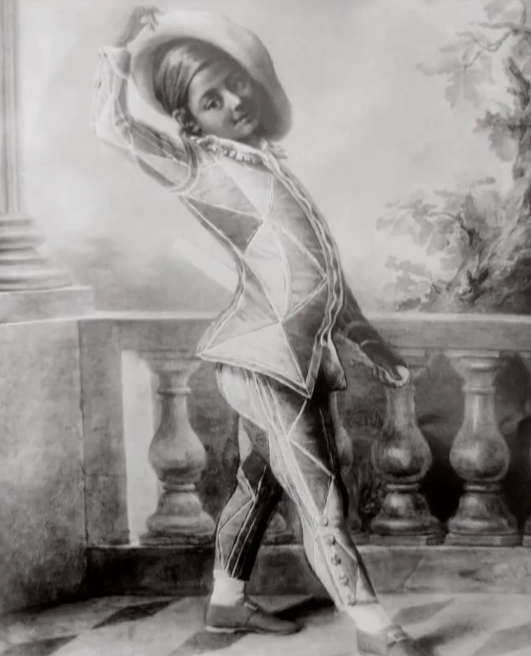
This might be the only real likeness of Zamor. This is the Drouais portrait, destroyed by fire and only known through photographs.
François-Hubert Drouais, presumed portrait of Zamor. Screenshot from Le « négrillon » de Versailles, in the series Quelle histoire ! Enquête sur la toile, directed by Elisa Helain, CAPA Presse / ARTE, 2024.
Some of the most entertaining stories about him are less secure still than the paintings. In the supposedly autobiographical Memoirs of the Comtesse du Barry, a pie releases a swarm of May bugs at dinner. Zamor chases them, then snatches off Chancellor Maupeou’s wig when the insects take shelter in it.
This is a vivid scene one could imagine. It also comes from memoirs fabricated by Étienne-Léon de Lamothe-Langon (a novelist and literary forger) and first published in 1829. Du Barry did not write these memoirs. Lamothe-Langon’s imagined du Barry calls Zamor a “puppet or plaything”, while his editorial voice condemns Zamor’s subsequent conduct towards her.[^5]
In chapter XXIV of the fabricated memoirs, Lamothe-Langon’s imagined Madame du Barry says, in the English translation:
“Zamor fancied himself the equal of all he met, scarcely deigning to acknowledge the king himself as his superior.”
The book is useful evidence of how later readers were invited to picture their relationship. It cannot establish that the beetles ever flew out of the pie, or that du Barry used any of these words.
Another story claims Louis XV made Zamor governor of Louveciennes as a joke. Charles Vatel (du Barry’s nineteenth-century biographer, whose book appeared in 1883) searched unsuccessfully for the appointment and challenged the claim. He wanted to defend the countess against slander, but did not accept every story told about her.[^2]
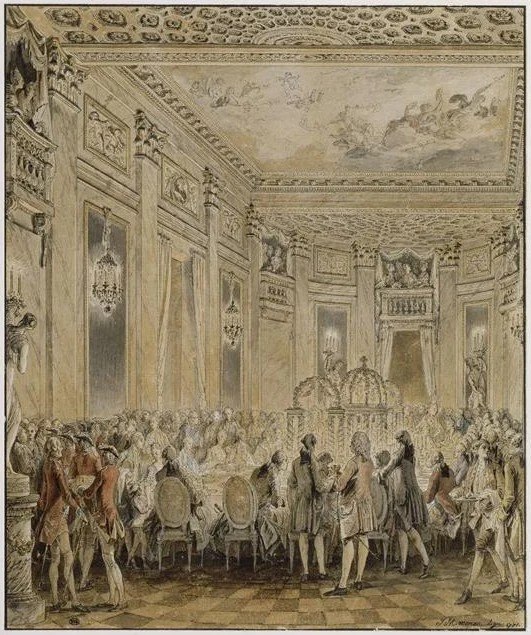
Madame du Barry entertains Louis XV at the inauguration of her pavilion at Louveciennes, 2 September 1771. Designed by Claude-Nicolas Ledoux, the building is now known as the music pavilion.
By Jean-Michel Moreau - Unknown source, Public Domain, https://commons.wikimedia.org/w/index.php?curid=763166
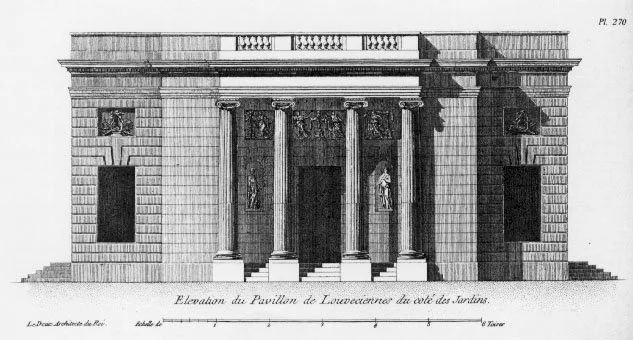
The garden façade of Madame du Barry’s music pavilion at Louveciennes, designed by Claude-Nicolas Ledoux and inaugurated in 1771.
Architectural drawing by Ledoux. Image: Wikimedia Commons, public domain. https://commons.wikimedia.org/w/index.php?curid=762635
Zamor grew up. After Louis XV’s death in 1774, du Barry lost her place at Versailles, and Zamor remained associated with her household at Louveciennes. During the Revolution, their political positions diverged. He, by that time an adult, became involved in revolutionary circles and worked with George Greive, an energetic opponent of the countess.[^6]
Du Barry’s prosecution developed around several accusations and witnesses. A theft of her jewels had prompted journeys to England; those journeys, her aristocratic connections and her alleged assistance to émigrés were turned against her. Zamor testified about the political sympathies of her visitors, including their pleasure at Republican military setbacks, stating that they were not "patriots." She was executed on 8 December 1793.[^6]
His evidence was damaging. There is no need to minimise that. But describing him as the man who sent her to the guillotine compresses a prosecution, a political campaign and a tribunal’s decision into the act of one single witness.
We cannot confidently separate political conviction, resentment, pressure and self-interest in his motives. Nor should we assume that his attachment to revolutionary ideas was merely an excuse for personal revenge.
An ARTE investigation into Zamor’s life (a documentary released in 2024) follows a particularly revealing part of the story: his own imprisonment. After du Barry’s execution, his former association with her helped make him suspect too. One has to wonder— did he have any choice but to testify against her? Was there really an option not to? [^7]
Letters sought to clear his name and release him. In one, dated 2 January 1794, Greive, writing to Fouquier-Tinville (the Revolutionary Tribunal’s public prosecutor), described a child brought to Europe as a joujou—a plaything—and praised his study of the philosophers Rousseau and Mably. He also invoked supporters at the Café Procope (which was a popular meeting place for revolutionaries—see the picture below). These were people who recognised Zamor as a fellow patriot and wanted him freed.[^8]
Badoureau, after Kretz, Le café Procope au XVIIIème siècle. Paris Musées / Musée Carnavalet, CC0.
Greive had helped pursue du Barry. He was defending an associate and writing to persuade a revolutionary official, so his account needs scrutiny. Nevertheless, it establishes that the verdict on Zamor was disputed at the time. The claim that he had been treated as a plaything was already being made by a contemporary supporter.
The doctor François-Louis Poumiès de la Siboutie (whose memoir, Souvenirs d’un médecin de Paris, was published posthumously in 1910) recalled meeting Zamor in Paris in 1811, when he was earning money through writing lessons and playing the violin at dances. He found him educated and well mannered, with fascinating court recollections which, frustratingly, he did not write down. How fascinating it would be to read Zamor’s memoirs. [^9]
On one occasion, somebody accused Zamor of having brought his benefactress to the scaffold. According to the doctor, Zamor burst into tears and vehemently denied the accusation.
His tears do not explain exactly what he denied; the doctor remained unconvinced. The memoir by Poumiès was another one published much later. Still, it gives us something the stock portrait of the treacherous servant usually lacks: a living person confronted with a devastating judgment.
In the same memoir, just before his account of Zamor, Poumiès records the marquis d’Argicourt (du Barry’s brother-in-law) defending her by reference to her upbringing and circumstances. By the next generation, a sympathetic account was already being articulated. Her background could help explain her choices. Zamor’s lost childhood was less readily allowed to explain his.[^9]
That does not mean public opinion about du Barry changed unanimously or overnight. But her execution offered later writers a tragic ending around which to reshape her life in retrospect. In a story organised around the suffering of a generous woman, her former dependant could become the villain.
Rue Maître-Albert photographed in the late 1880s. If I have identified it correctly, Zamor’s building was the one on the right. (Obviously this was long after his death.)
Eugène Atget, Rue Maître-Albert. Paris Musées / Musée Carnavalet, CC0
The later evidence about Zamor’s life in my street deserves particular attention. In March 1875, Vatel interviewed Madame Lejeune, whose parents had been Zamor’s landlords. In Vatel’s published account (du Barry’s nineteenth-century biographer), she recalled Zamor’s bitterness about being humiliated in du Barry’s household, accused him of beating a pupil, and remembered his growing poverty.[^1]
An allegation about his treatment of a child should not be brushed aside because we dislike the judgments made about the perpetrator. Neither should an interview conducted more than fifty years after his death be treated as an exact record.
One discrepancy makes the problem of gathering later witness accounts wonderfully concrete. Madame Lejeune remembered three francs beside his deathbed. In a footnote to her statement, Vatel noted that the inventory recorded fifty-three. She insisted her memory was right.[^1]
It does not make her whole account worthless; it does remind us that precision of detail and confidence of recollection are different things from accuracy.
Her family’s moral judgment is equally clear. According to Vatel, Madame Lejeune reported her mother’s belief that Zamor’s miserable end was deserved: du Barry had been his benefactress, and he ought to have defended her. That conviction was part of the evidence Vatel collected, and part of the atmosphere in which his later life was remembered.[^1]
G. Lenotre (a French historian whose real name was Théodore Gosselin) carried the story from Vatel’s research into his biographical sketch “La fin de Zamor”, translated by Frederic Lees in 1908 as “Zamor’s End”. He acknowledged recollections of humiliation, yet also described Zamor’s conduct towards du Barry as ingratitude. Then he moved into something much more speculative: imagining the old man’s thoughts, his memories of court splendour and the execution that must have haunted him.[^10]
Lenotre ended the story with a bare coffin, indifferent neighbours and a hearse followed by nobody. He claimed that onlookers remarked: “It’s Zamor, the negro who betrayed Mme. du Barry.”
It is a pitiful and tragic ending. But its emotional certainty goes well beyond what we can establish about Zamor’s inner life.
Georges Cain (a historian of Paris) was more openly contemptuous of Zamor. In the English translation of his Walks in Paris (1909, translated by Alfred Allinson), the former Carnavalet curator calls Zamor an “ill-conditioned ape” and accuses him of “villainous ingratitude”. The contempt is racial as well as moral. A child’s presence at court is treated as a privilege that should have purchased the adult’s loyalty. And this is not even considering the circumstances by which the child arrived at the court. [^11]
The account of Zamor's later life continued to circulate. Jacques Levron (a French historian) drew on Lenotre in his 1973 biography of du Barry, describing Zamor as hated by his neighbours and buried without mourners. The Paris historian Jacques Hillairet’s street dictionary (first published in 1963) also repeats the supposed circumstances of his funeral. These repetitions helped the story acquire authority, but they do not amount to several independent witnesses to an event in 1820.[^12]
The remark about betraying du Barry comes from Lenotre’s account, written many decades after Zamor’s death. Without a securely identified contemporary source for the words he attributed to onlookers, we cannot establish that anyone actually said any such thing at the funeral.
What emerges is a reputation shaped by several kinds of evidence: accounts and registers, political appeals, old neighbours’ memories, invented memoirs and historians with strong feelings about their subjects. Each can tell us something. They cannot all tell us the same things.
Du Barry’s education of Zamor mattered. Affection may have existed between them. Her execution was appalling, and his testimony helped the case against her. Those facts deserve consideration alongside the circumstances that placed him in her household.
But the expectation of gratitude is much harder to accept. An education did not cancel the loss of his family. Fine clothes did not give him an ordinary childhood. Whatever kindness he received, he was entitled to become an adult with convictions that differed from hers.
Calling him an ungrateful betrayer settles that argument before it begins. It makes loyalty to his former mistress the measure of his whole life, while leaving her power over his childhood largely unexamined.
I cannot recover all that Zamor thought or felt. I can, however, question the confidence with which other people supplied his motives, imagined his remorse and made his poverty seem deserved. When I pass the house in my street, it is that man I want to remember: somebody whose life deserves more consideration than the verdict attached to his name.
Footnotes and References
[^1]: Charles Vatel, Histoire de Madame du Barry d’après ses papiers personnels et les documents des archives publiques (Versailles: L. Bernard, 1883), vol. III, pp. 364–368. Includes the address identification and Madame Lejeune’s statement dated 22 March 1875. Vatel’s note on p. 367 gives fifty-three francs against her recollection of three. Digitised volume.
[^2]: Vatel, Histoire de Madame du Barry, vol. II, pp. 146–152: origins, baptismal register transcribed on p. 148, suppliers’ accounts, and examination of the alleged governorship. The baptism is dated 4 July 1772; both godparents were represented by proxies. Digitised volume.
[^3]: Raffaella Sarti, “From Slaves and Servants to Citizens? Regulating Dependency, Race, and Gender in Revolutionary France and the French West Indies”, International Review of Social History, 67:1 (2022), pp. 65–95, especially the discussion of metropolitan slavery and the Paris courts. Article. This provides legal and social context, rather than proof of Zamor’s individual legal status.
[^4]: Musée Carnavalet / Paris Musées, Portrait présumé de Zamor (vers 1762–1820), page de Mme du Barry, historical commentary.
[^5]: Étienne-Léon de Lamothe-Langon, Mémoires de Madame la comtesse Du Barri (1829), apocryphal memoirs. The English version, Memoirs of the Comtesse du Barry, chapter XXIV, contains the plaything description and the May bug story. Text and editorial identification of its author.
[^6]: French Ministry of Justice, “Le procès de Jeanne du Barry”, 30 July 2012; Vatel, vol. III, trial material, including Zamor’s evidence. The Ministry’s page is a modern narrative with its own strongly expressed judgements, not the original court record.
[^7]: Elisa Helain, director, Le “négrillon” de Versailles, in Quelle histoire ! Enquête sur la toile (CAPA Presse / ARTE, 2024), documentary. Its final section discusses the prosecution, Zamor’s imprisonment, supporting letters and estate inventory. The capture story is an attributed account; examples of prices paid for other enslaved children do not establish Zamor’s purchase price. Link to the ARTE documentary: https://www.arte.tv/fr/videos/116816-001-A/quelle-histoire-enquete-sur-la-toile/
[^8]: George Greive to Fouquier-Tinville, 2 January 1794, reproduced in Vatel, vol. III, pp. 363–364; accompanying correspondence on pp. 360–362.
[^9]: François-Louis Poumiès de la Siboutie, Souvenirs d’un médecin de Paris, published by his daughters, with introduction and notes by Joseph Durieux (Paris: Plon, 1910), pp. 28–29. The encounter with Zamor is placed in 1811; the preceding passage records a sympathetic defence of du Barry by another acquaintance. Digitised text.
[^10]: G. Lenotre, “La fin de Zamor”, in Vieilles maisons, vieux papiers; consulted in Frederic Lees’s English translation, “Zamor’s End”, Romances of the French Revolution, vol. I (London: William Heinemann, 1908), pp. 134–138. The alleged funeral remark appears on p. 138. Digitised text.
[^11]: Georges Cain, Walks in Paris, translated by Alfred Allinson (1909), p. 69. The quoted phrases are from the English translation. Digitised edition. Cain’s identity and curatorship are documented by Paris Musées.
[^12]: Jacques Levron, Madame du Barry ou la fin d’une courtisane (Paris: Perrin, 1973), p. 319; Jacques Hillairet, Dictionnaire historique des rues de Paris, vol. II, pp. 89–90, entry “Maître-Albert (rue)”.