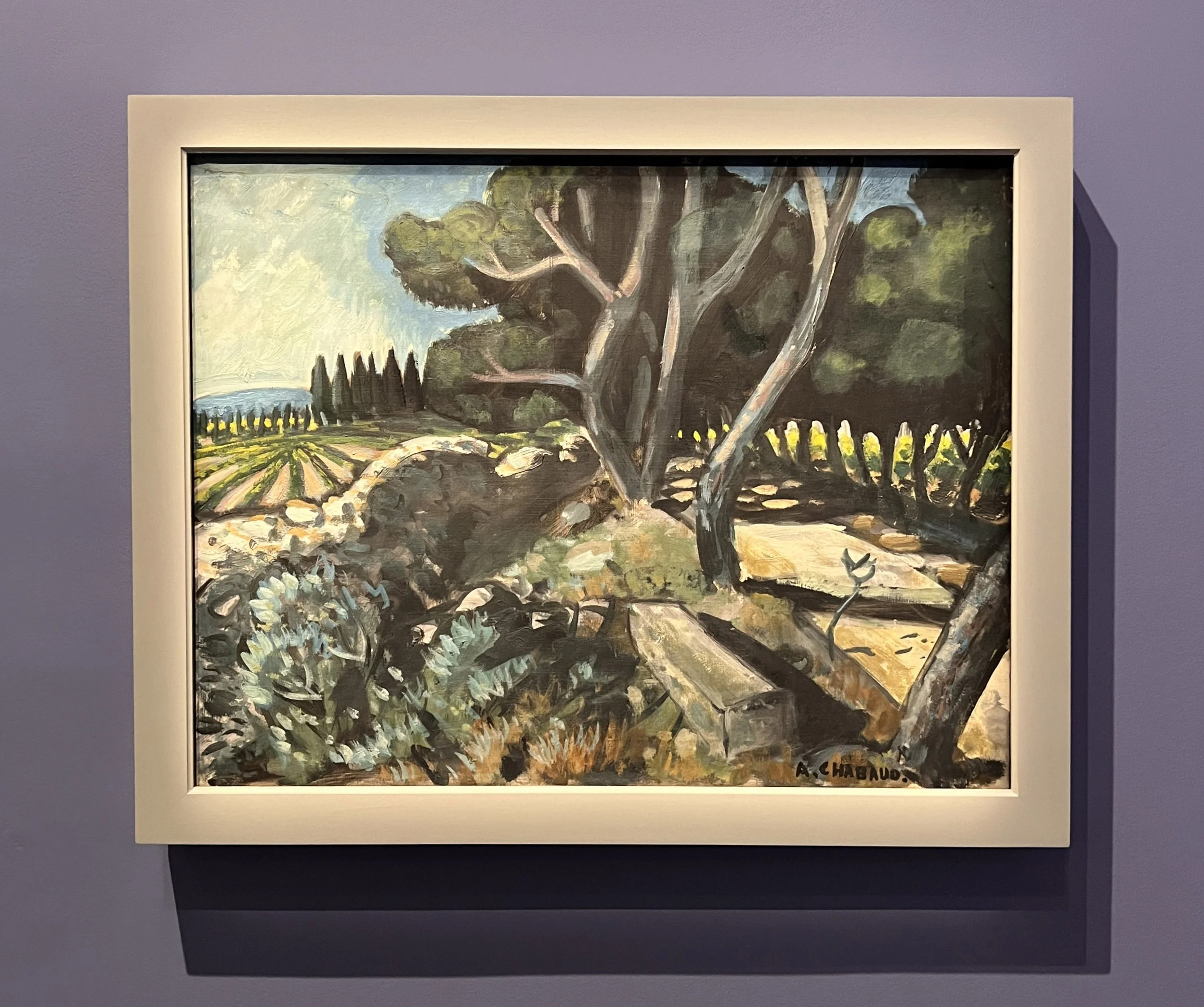
Auguste Chabaud, Paysage de Provence, around 1930. Musée d’Art moderne de Paris.
Photograph: Paris Footprints
A pale track runs between trees and low stone walls. Beyond it are cultivated rows, a line of cypresses and a glimpse of distant blue. The scene is Auguste Chabaud’s Paysage de Provence, painted around 1930.[^1]
Chabaud had served in the artillery during the First World War; his brother Pierre was killed at Verdun in 1916. In 1919, he returned to the family property at Graveson, in Provence, and settled there. The landscape around him became one of his principal subjects.[^2]
The Musée Auguste Chabaud quotes his response to returning from the war: “After spending four years facing death, it is harder now to find oneself facing life.” During his service, he drew soldiers’ daily lives in their dugouts and later described them in La Leçon des cagnas, completed in 1922. His account includes soldiers carving walking sticks and making rings.[^2]
That connection between a landscape and the human experiences behind it runs through Histoires de paysages—De Monet à Hockney (1890–2026) at the Musée Marmottan Monet. The exhibition explores how artists have used landscape to respond to the world they lived in, from war and national identity to memory and environmental change. Its opening example is Monet’s offer of two Nymphéas paintings to France immediately after the Armistice in November 1918, to celebrate the victory.[^3]
The exhibition also examines the role of landscape in the development of abstraction. Two paintings by Piet Mondrian, made four years apart, illustrate stages in that development.
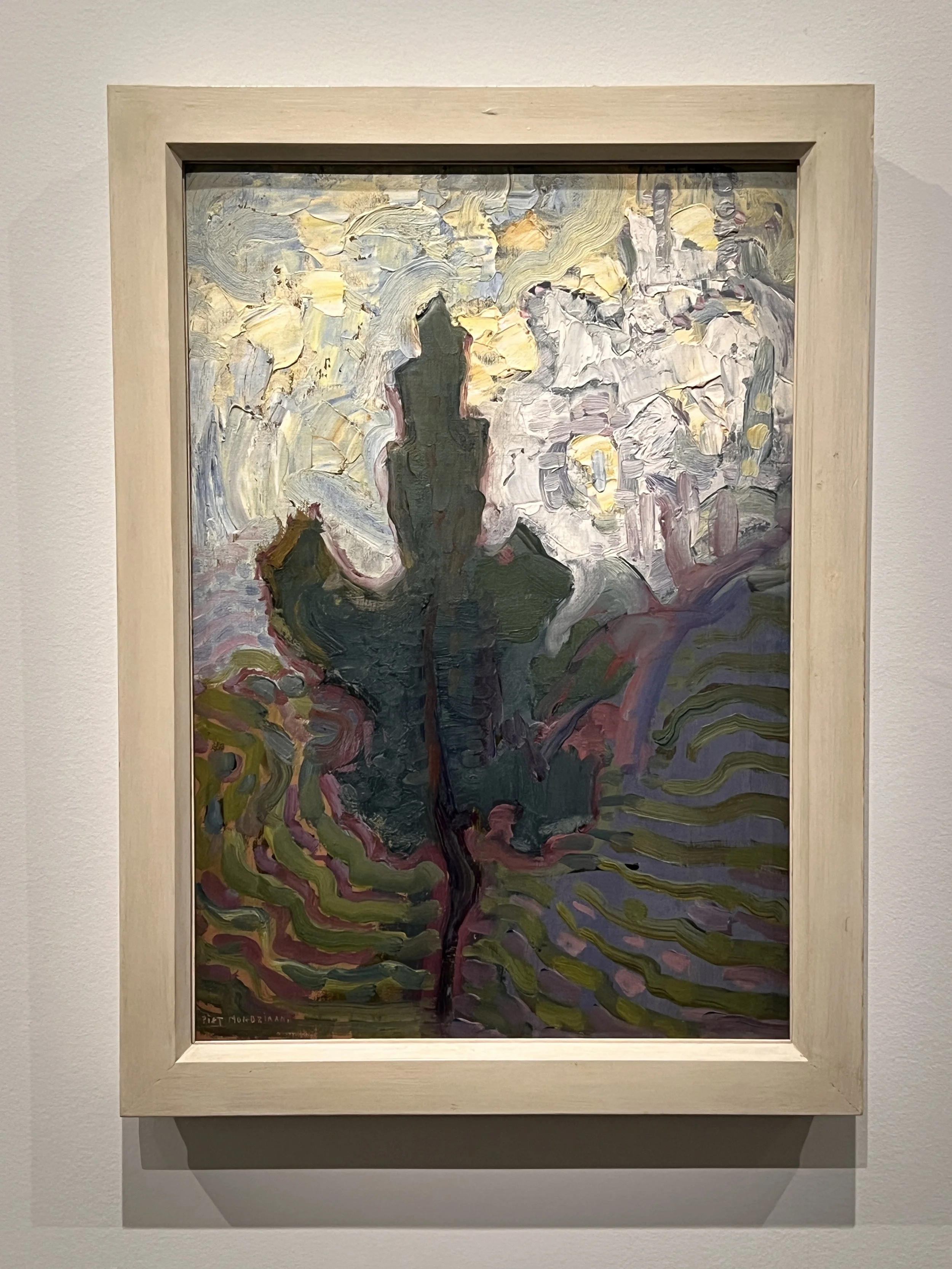
Piet Mondrian, Arbre, 1908. Kunstmuseum Den Haag
Photograph: Paris Footprints
His Arbre, painted in 1908, shows a dark tree surrounded by greens and purples, beneath a sky painted in thick strokes of pale colour.[^4]
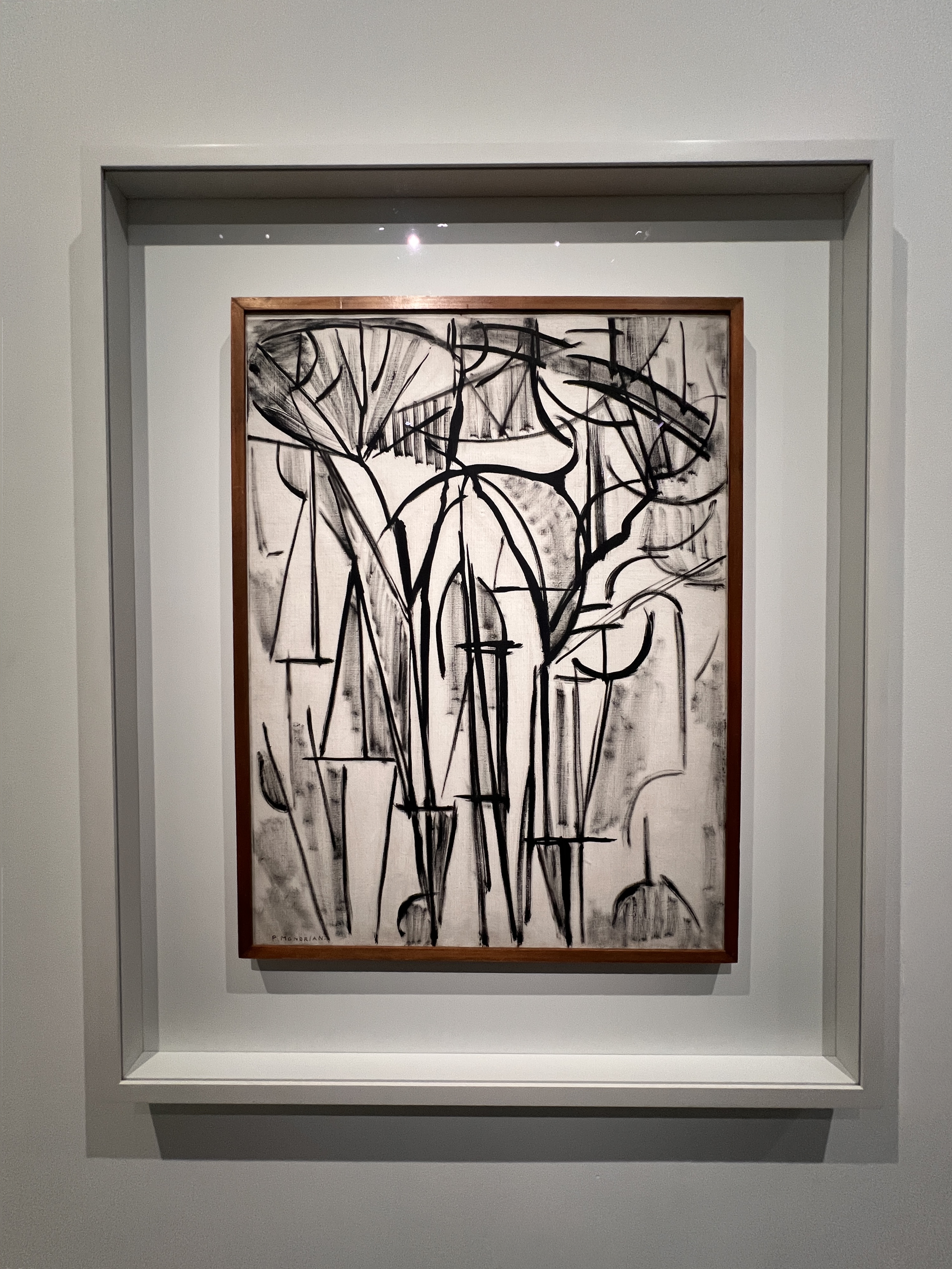
Piet Mondrian, Composition Arbres I, 1912. Kunstmuseum Den Haag
Photograph: Paris Footprints
In Composition Arbres I, painted in 1912, trunks and branches are reduced to a network of black lines against a pale ground. Mondrian’s encounter with Cubism in Paris helped him develop this approach. He described his aim in these terms: “I abstract everything until I arrive at the fundamental quality of objects.”[^5][^6][^7]
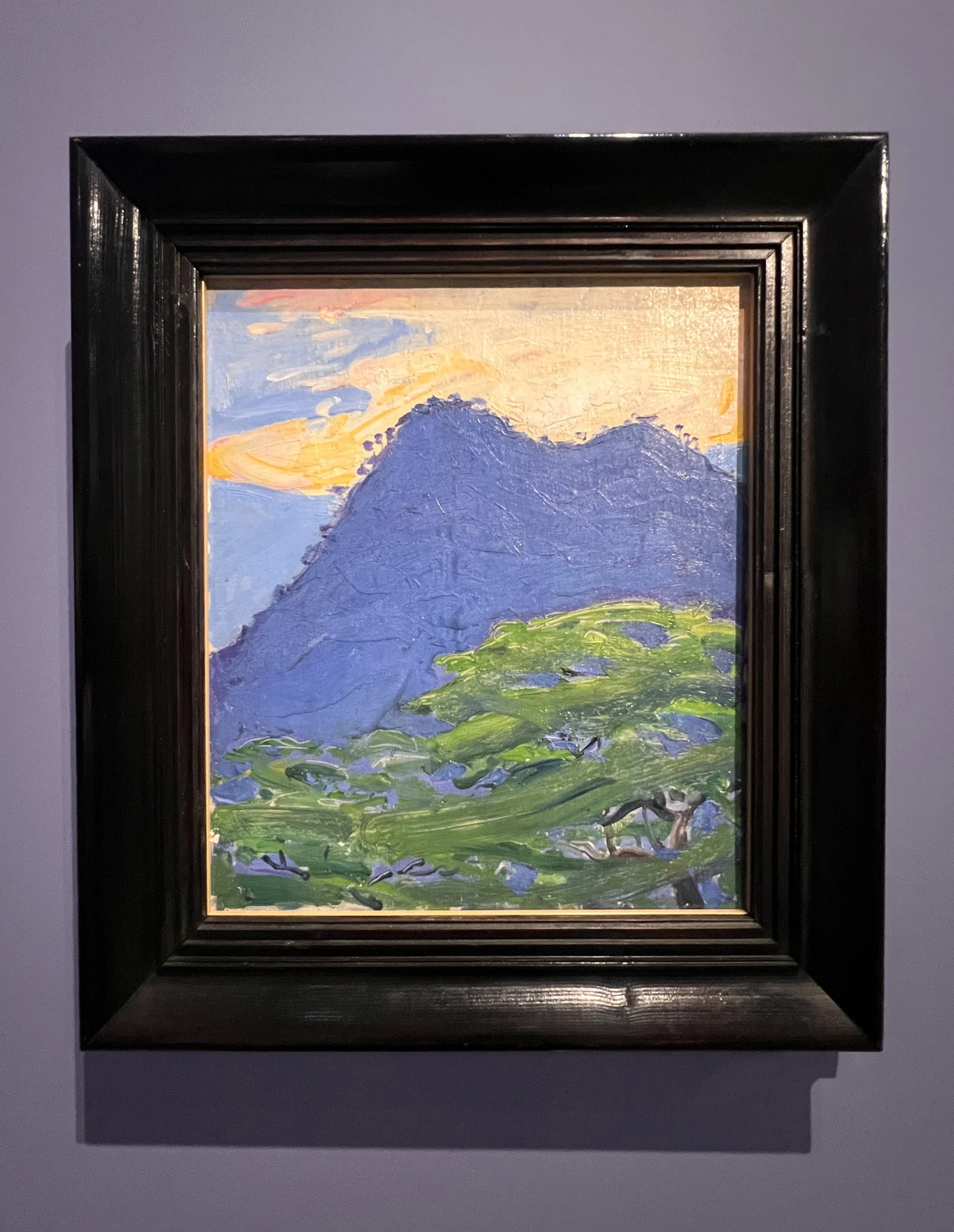
Akseli Gallen-Kallela, Hwandoni Hills, 1910. Gallen-Kallela Museum, Espoo
Photograph: Paris Footprints
In Akseli Gallen-Kallela’s Hwandoni Hills, painted in 1910, a blue-violet mountain fills much of the picture. Green branches spread across the foreground beneath a yellow and apricot sky.[^8]
Gallen-Kallela was Finnish, but these hills are in Africa. He lived with his family in what was then British East Africa, now Kenya, from 1909 to 1910. During that stay he produced around 170 small paintings, experimenting with a boldness of colour that marked a change in his work. “I walk in a mere ecstasy of beauty,” he wrote in 1909.[^9]
The family lived outside Nairobi, and the children attended an English school. Their photographs, around 300 in all, document big-game hunting as well as their other experiences. Gallen-Kallela also assembled ethnographic, zoological and botanical collections.[^9]
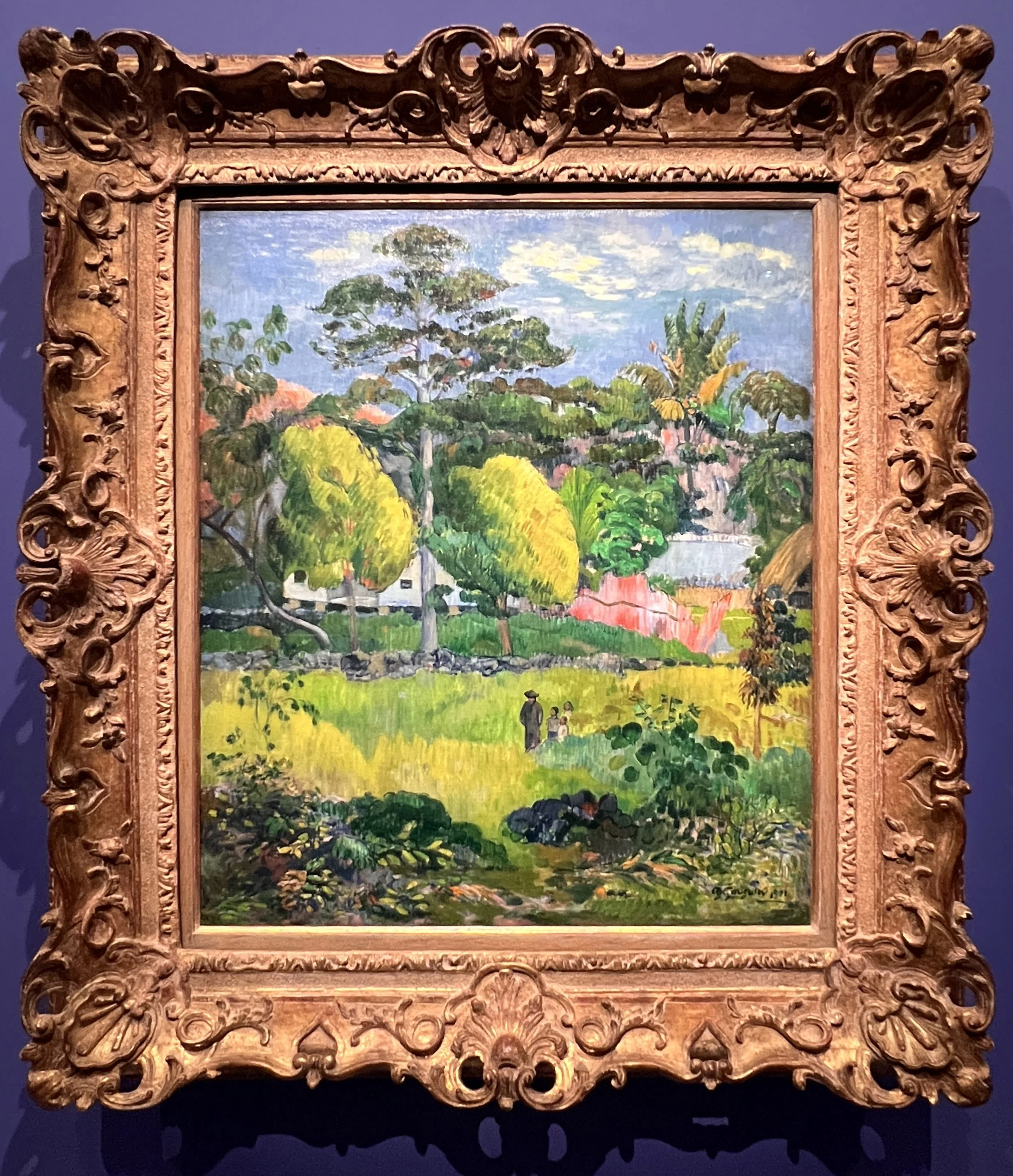
Attributed to Paul Gauguin, Paysage, 1901. Musée de l’Orangerie
Photograph: Paris Footprints
The Paysage of 1901, attributed to Paul Gauguin, shows dense tropical vegetation, with a small group of figures near the bottom: an adult in black, followed by children.[^10]
The Musée de l’Orangerie, which owns the painting, identifies the adult as an apparent missionary priest. The work was once called Le Curé et les enfants—“The Priest and the Children”. It probably depicts Hiva Oa in the Marquesas, where Gauguin moved in 1901, two years before his death.[^10]
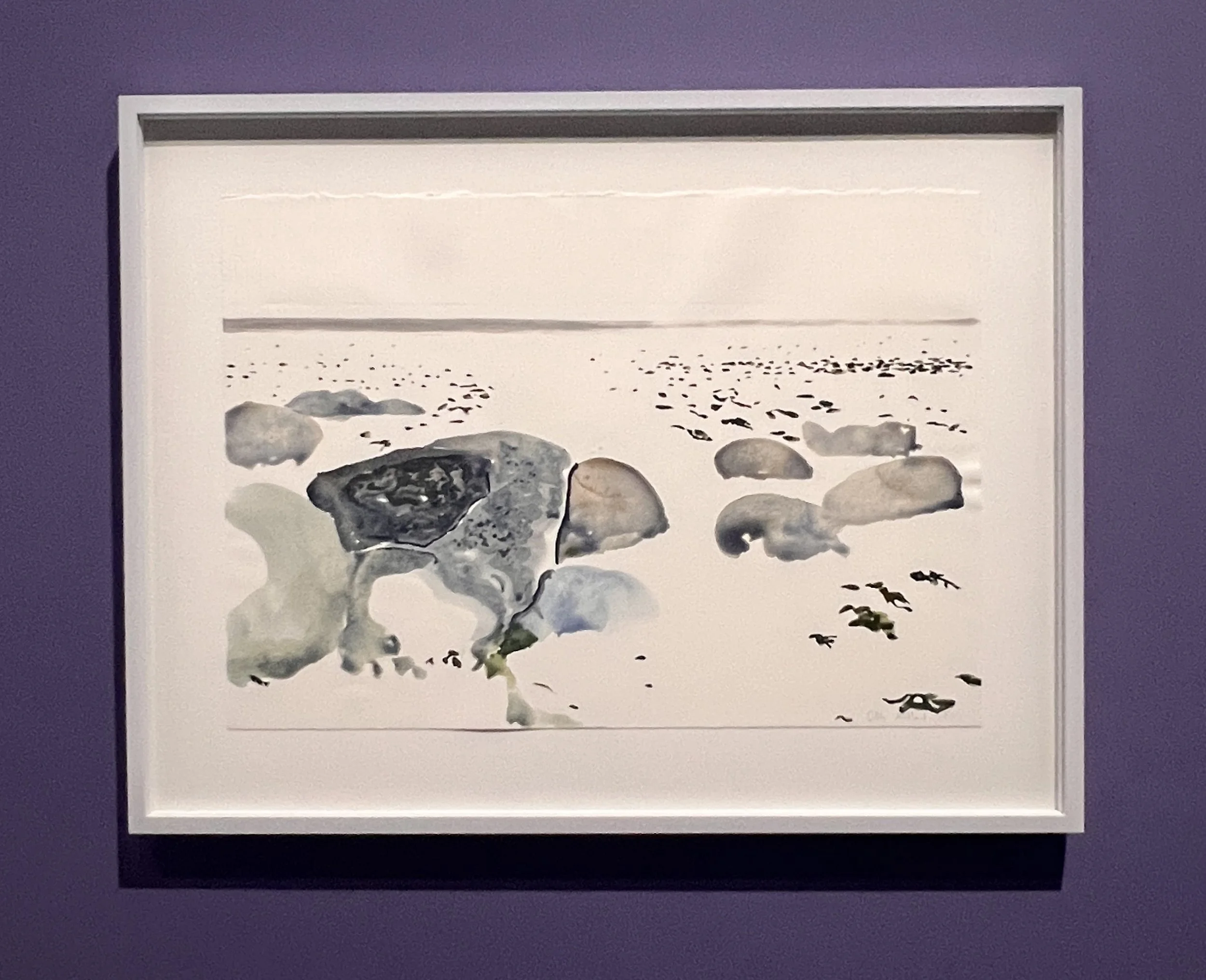
Gilles Aillaud, Marée basse, rochers, 1983, watercolour on paper
Photograph: Paris Footprints
Gilles Aillaud’s Marée basse, rochers, a watercolour of 1983, depicts a shore at low tide. Grey and blue washes define the larger rocks, with smaller dark marks scattered towards the distance. Much of the paper remains white.[^11]
Aillaud, better known for his paintings of wild animals in captivity, also painted a series of beach scenes on France’s northwestern coast during the 1980s. He said: “I paint things, I am absolutely incapable of painting an idea.”[^11]
The exhibition places landscape within the history of its time. Chabaud’s return from war, Gallen-Kallela’s travels and Mondrian’s experiments with abstraction all shaped their work. Their paintings record a relationship between an artist and a place, formed under particular historical circumstances. Understanding those circumstances helps explain both the subjects they chose and the ways they represented them.
Histoires de paysages. De Monet à Hockney (1890–2026) is at the Musée Marmottan Monet until 31 January 2027.[^3]
Footnotes and References
[^1]: Paris Musées, Musée d’Art moderne de Paris, “Paysage de Provence”, Auguste Chabaud, around 1930; inventory number AMVP 484. The work also bears the attributed title Pins et Cyprès.
https://www.parismuseescollections.paris.fr/fr/musee-d-art-moderne/oeuvres/paysage-de-provence
[^2]: Musée Auguste Chabaud, “La grande guerre (1914–1919)”. Source for Chabaud’s military service, his brother’s death, his return to Provence and La Leçon des cagnas. The quotation about facing life after the war is translated from the French wording reproduced by the museum.
[^3]: Musée Marmottan Monet, “Histoires de paysages. De Monet à Hockney (1890–2026)”, exhibition presentation and press dossier, particularly the sections “Nymphéas pour l’histoire” and “Abstraire la nature”. These explain the exhibition’s historical approach and Monet’s offer to the French state following the Armistice.
Exhibition: https://www.marmottan.fr/expositions/histoires-de-paysages/
Press dossier: https://www.marmottan.fr/wp-content/uploads/2026/05/HIST_PAYSAGES-DP-260909-1.pdf
[^4]: Kunstmuseum Den Haag, “Tree”, Piet Mondrian, 1908, oil on canvas, 50 × 35.5 cm; object number 0334219; bequest of Salomon B. Slijper. Exhibited under the French title Arbre.
https://www.kunstmuseum.nl/en/collection/tree
[^5]: Kunstmuseum Den Haag, “Composition Trees 1”, Piet Mondrian, 1912, oil on canvas, 81 × 62 cm; object number 0334315; bequest of Salomon B. Slijper.
https://www.kunstmuseum.nl/en/collection/composition-trees-1
[^6]: Kunstsammlung Nordrhein-Westfalen, “Piet Mondrian”, chapter 3, on Mondrian’s encounter with Cubism and the progressive abstraction of his tree paintings.
https://www.kunstsammlung.de/en/mondrian/chapter03
[^7]: Museum of Modern Art, New York, “Piet Mondrian: Pier and Ocean 5 (Sea and Starry Sky)”, collection commentary and gallery text. The entry reproduces Mondrian’s statement about abstracting objects to their fundamental qualities and discusses his exposure to Cubism in Paris.
https://www.moma.org/collection/works/33419
[^8]: Gallen-Kallela Museum, “Hwandoni Hills”, Akseli Gallen-Kallela, 1910; collection record GKM-4390, available through Finna.
https://www.finna.fi/Record/gallenkallela.8C69A328AB7149D5B42D0EE0A37E2BC0?lng=en-gb
[^9]: Europeana, “On safari: Gallen-Kallela in Africa”, part of the online exhibition An Ecstasy of Beauty. Source for the family’s residence in British East Africa, the paintings, photographs and collections. The quotation comes from Gallen-Kallela’s contribution to Hufvudstadsbladet, 29 October 1909, in the English translation reproduced by Europeana.
https://www.europeana.eu/en/exhibitions/an-ecstasy-of-beauty/on-safari-gallen-kallela-in-africa
[^10]: Musée de l’Orangerie, “Paysage”, 1901, attributed to Paul Gauguin; inventory number RF 1963 107. The museum discusses the probable identification of Hiva Oa, the apparent missionary and the former title Le Curé et les enfants.
https://www.musee-orangerie.fr/fr/oeuvres/paysage-196119
[^11]: The title, date and medium of Marée basse, rochers follow the exhibition label photographed during the visit. For Aillaud’s beach paintings and the quotation, see Christie’s, “Gilles Aillaud: Marée basse, vers de vase”, lot essay for a separate painting dated 1987. The essay reproduces the quotation in French and English and discusses his beach scenes of the 1980s.