Half an hour west of the centre, La Muette felt like a very different Paris.
I walked through the Jardin du Ranelagh to the Musée Marmottan Monet. The park was especially pretty in its autumn colours, and the grand apartment buildings made the neighbourhood’s affluence unmistakable.
That setting made me think about this corner of Passy and how it had changed. The building that contains the museum began as a hunting pavilion beside the Bois de Boulogne in 1863, just after Passy was incorporated into Paris. Around it, the old estates gave way to a very different neighbourhood: the former grounds of the Château de la Muette were divided up, part becoming the public garden of the Ranelagh, while wealthy residents built grand houses nearby. Over the following decades—and into the early twentieth century—spacious apartment blocks joined them, turning this verdant edge of the city into one of its most prestigious residential districts.[^1]
Around 1910, nearly a century after the First Empire ended, Paul Marmottan enlarged the house and refurnished its rooms in the Empire style to display his collection. He filled it with furniture, paintings and decorative objects, and left it and his collections to the Académie des Beaux-Arts. The museum opened in 1934.[^2] Monet’s paintings arrived later, through gifts and bequests, including the collection left by his son Michel.[^3]
I was particularly taken by a painting by Gustave Caillebotte in one of the Empire-style rooms. The green walls showed off the Impressionist paintings beautifully. I was familiar with this one but had never seen the original before. The contrast between the room’s formal, historic décor and Caillebotte’s view of an angular, modern streetscape was striking. The two styles belonged to very different worlds, yet somehow, each drew attention to the other.
The painting is Rue de Paris. Temps de pluie—Paris Street; Rainy Day—a preparatory study for the much larger version now in Chicago. Caillebotte painted it in 1877, showing people crossing a junction in the Quartier de l’Europe: the meeting of the rues de Turin and de Moscou, near the Gare Saint-Lazare. The streetlamp divides the scene; umbrellas, wet paving and the couple approaching in the foreground make it feel like a moment glimpsed while walking through the city.[^4]
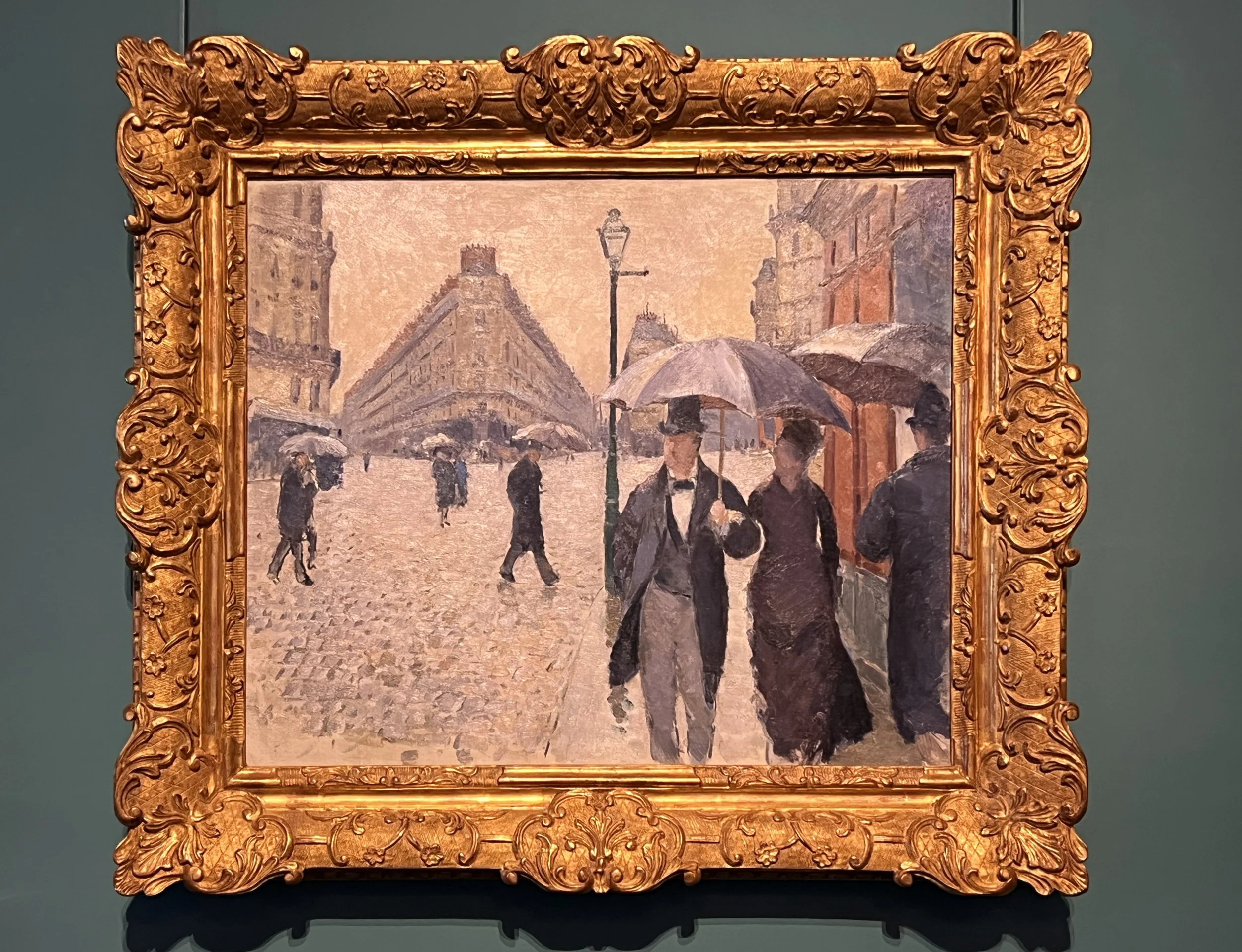
Gustave Caillebotte, Rue de Paris. Temps de pluie (1877; preparatory study), Musée Marmottan Monet. Photograph: Paris Footprints
What occurred to me was how new this cityscape still was at that time. The Quartier de l’Europe had been planned in the 1820s, but its streets and buildings were completed in stages; the junction Caillebotte depicted had only recently taken shape. The great rebuilding of Paris under Haussmann had begun just twenty-four years before the painting was made. Caillebotte was painting a city that looked modern to its first viewers, its new streets and apartment blocks part of a dramatic transformation.[^5]
People at the time were already debating what this new Paris was gaining and losing. Writing in 1865, while the works were still underway, Victor Fournel—a French journalist, writer and historian, especially interested in the history of old Paris—acknowledged the city’s “grand and monumental” aspect, and its new “air, light and space.” But he also criticised what he called “the monotonous sameness of a banal magnificence.” It is a striking comment on those imposing, regular apartment buildings: admired for their grandeur and order, yet faulted for making the city less varied.[^6]
That transformation also changed who lived where. As the centre became more bourgeois, many poorer residents displaced by demolition and rising rents moved towards the eastern and outer districts. Caillebotte’s painting gives us the polished western side of this new Paris, with its fashionable pedestrians and recently built streets. It is a beautiful scene, but also a record of a city being remade, and of its social geography shifting along with it.[^7]
I left thinking about the layers in that room: Paul Marmottan’s recreation of an Empire interior, the Impressionist paintings that arrived later, and Caillebotte’s picture of a neighbourhood that was itself still new.
I have a lot more to say about Haussmann and contemporary opinion about his remodeling of Paris. I'll share more about what I've been reading on that topic another day. I did actually go to the Musée de Marmottan Monet to see an exhibition about landscape—but I'll write about that another day as well.
Footnotes and References
[^1]: Musée Marmottan Monet, “The Museum and Its History”, on the Château de la Muette grounds, the Ranelagh garden, the 1863 plot and the development of the property; Académie des beaux-arts, “Le Musée Marmottan Monet”, which describes the original property as a hunting pavilion. Both accessed 1 November 2026. Musée Marmottan Monet
[^2]: Musée Marmottan Monet, “The Museum and Its History”, on Paul Marmottan’s enlargement and refurnishing of the house around 1910, his bequest to the Académie des Beaux-Arts, and the museum’s opening in 1934. Accessed 1 November 2026. Musée Marmottan Monet
[^3]: Musée Marmottan Monet, “The Museum and Its History” and “Donors”, on the Impressionist gifts and Michel Monet’s 1966 bequest of more than one hundred paintings by his father. Accessed 1 November 2026. Musée Marmottan Monet
[^4]: Musée Marmottan Monet, collection entry for Gustave Caillebotte’s Rue de Paris. Temps de pluie, identifying the 1877 painting as a study for the Art Institute of Chicago version and locating the scene at the intersection of rues de Turin and de Moscou, near Place de l’Europe. Accessed 1 November 2026. Musée Marmottan Monet
[^5]: Ville de Paris, Parcours Europe: présentation, textes et tableaux, especially the section on Caillebotte and Place de Dublin; Ville de Paris, “Haussmann, l’homme qui a transformé Paris”, for the timing and effects of the works. Accessed 1 November 2026. cdn.paris.fr
[^6]: Victor Fournel, Paris nouveau et Paris futur (Paris: Jacques Lecoffre, 1865), concluding assessment of what Paris had gained and lost through its transformation. The English renderings of Fournel’s phrases here are mine. For Fournel’s biographical description, see the Comité des travaux historiques et scientifiques notice, which describes him as a journalist, writer and scholar interested in old Paris and theatre. Accessed 1 November 2026. gutenberg.org
[^7]: Ville de Paris, “Haussmann, l’homme qui a transformé Paris”, on the social cost of the transformation and the movement of poorer residents towards the faubourgs; E. Canfora-Argandona and R.-H. Guerrand, La répartition de la population, les conditions de logement des classes ouvrières à Paris au XIXe siècle (Paris: Centre de Sociologie Urbaine, 1976), reviewed in Population 32, no. 3 (1977), p. 727. The review discusses the movement of workers and artisans towards eastern peripheral districts and the settlement of wealthier residents in the west. Accessed 1 November 2026.